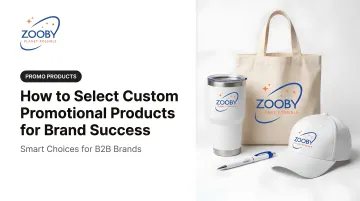
The stakes are real. Product-audience misalignment, poor customization, and skipped distribution planning are among the costliest mistakes in promotional marketing. This guide walks through a clear, practical framework for avoiding all three — from defining goals and selecting products to customizing them well and getting them into the right hands.
Key Takeaways
- Custom promotional products are branded items (imprinted, embroidered, engraved, or custom-manufactured) used to build awareness and loyalty
- The core selection factors are: campaign goals, audience fit, brand alignment, product quality, budget, and sustainability
- Customization quality — logo placement, decoration method, color accuracy — directly shapes perceived brand value
- Distribution planning (timing, quantity, fulfillment) is just as critical as product selection
- A full-service partner like Zooby Promotional connects you to both in-stock catalog items and fully custom-manufactured products
What Are Custom Promotional Products?
Custom promotional products are branded items — imprinted, embroidered, engraved, or manufactured to exact specification — used to represent a company's identity across marketing campaigns, employee programs, and client engagement.
The major categories include:
- Apparel and wearables — T-shirts, hats, outerwear, and performance wear
- Drinkware — mugs, tumblers, insulated bottles, stadium cups
- Bags and totes — reusable shoppers, backpacks, canvas totes
- Tech accessories — wireless chargers, USB drives, power banks
- Office supplies — notebooks, pens, desk organizers
- Fully custom-manufactured items — products built to exact client specifications beyond any standard catalog
Each category delivers different impression frequencies and use-case fits. A branded insulated tumbler travels daily; a pen stays at a desk. The category you choose determines how often your brand shows up in someone's life.
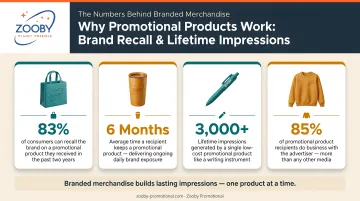
That staying power is what separates promotional products from most other marketing channels. According to PPAI research, 81% of recipients keep promotional products for more than one year, and nearly half hold onto them for over five years.
The reach compounds over time. The ASI 2026 Ad Impressions Study found that 85% of consumers remember the advertiser who gave them a promotional product, a recall rate that outperforms broadcast, online, and mobile advertising. The average branded item generates roughly 3,300 lifetime brand impressions at a cost-per-impression of just $0.006.
Key Factors for Selecting the Right Custom Promotional Products
Selecting promotional products is a strategic decision. The factors below connect product choices to measurable brand outcomes — not just what looks good in a catalog.
Define Your Campaign Goals First
Every product decision should start with a clear objective. Are you:
- Driving brand awareness at a trade show?
- Rewarding loyal customers or top clients?
- Onboarding new employees with a branded welcome kit?
- Generating engagement at a community or charity event?
The goal determines the appropriate product category, price point, and level of customization. A trade show giveaway prioritizes portability and volume; an executive gift program prioritizes quality and presentation. Without a defined goal, you end up with generic products that generate no measurable return.
Know Your Target Audience
The most effective promotional item is one the recipient will actually use. Consider demographics, interests, professional context, and the setting where they'll receive it.
Some examples of strong audience-product alignment:
- Tech professionals → wireless chargers, USB hubs, cable organizers
- Outdoor enthusiasts → insulated water bottles, packable bags, sunscreen
- University students → branded notebooks, pens, drinkware
- Corporate employees → premium apparel, padfolios, quality drinkware
The mismatches are just as instructive. Giving branded stress balls to financial executives or cheap plastic keychains to sustainability advocates signals that your brand isn't paying attention. PPAI's 2025 generational research found that apparel is the top-preferred category across Gen Z, Millennials, and Gen X — but secondary preferences differ significantly, with Gen Z favoring food and beverage items while Gen X leans toward office products and tech.
Align with Your Brand Identity
Promotional products are physical extensions of your brand. The materials, product category, and overall aesthetic must reflect your brand's values and positioning.
- A sustainability-focused company should avoid single-use plastics and opt for recycled or biodegradable alternatives
- A premium financial services brand should skip cheap giveaway pens and invest in high-end executive items
- A youth-oriented brand should lean into apparel and personalized products — 85% of Gen Z value personalized promotional products, compared to 39% of the general population
Brand inconsistency — mismatched colors, blurry logos, off-category products — erodes credibility rather than building it. When the product doesn't match the brand, recipients notice, even if they can't articulate why.
Prioritize Product Quality and Functionality
Low-quality items send a negative signal. A pen that fails after a week or a bag with a broken zipper gets thrown away and takes a piece of your brand's reputation with it.
75.4% of consumers keep promotional products primarily because they are useful. Novelty items that lack function get discarded quickly. Everyday items — drinkware, bags, tech accessories — generate impressions for years because recipients use them consistently.
Functional categories by lifetime impressions:
| Category | Lifetime Impressions |
|---|---|
| Outerwear | ~7,850 |
| Bags | ~5,772 |
| T-shirts | ~5,053 |
| Headwear | ~3,380 |
| Drinkware | ~3,162 |
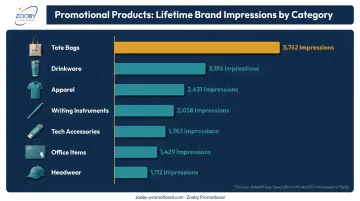
Drinkware alone is one of the most consistently requested promotional categories — which is why it remains a top product line at Zooby Promotional.
Establish a Clear Budget Framework
Budget planning must go beyond the unit price. The true cost of a promotional campaign includes:
- Per-unit product cost
- Decoration and setup fees (screen printing setups, embroidery digitizing)
- Minimum order quantities
- Shipping and packaging
- Any fulfillment or storage costs
Think in terms of cost-per-impression, not sticker price. A $15 insulated tumbler used daily for three years generates thousands of impressions at a fraction of a cent each. A $0.50 giveaway pen that disappears in a drawer generates almost none.
General budget tiers:
- Low ($0.50–$3): Pens, stickers, lanyards, silicone wristbands — high volume, broad distribution
- Mid ($3–$10): Tote bags, mugs, notebooks, basic tech accessories — strong utility, good brand exposure
- High ($10–$60+): Premium drinkware (YETI®, RTIC®, Stanley), quality apparel, executive gift sets — high impact, targeted distribution
A smaller order of well-chosen, high-quality items typically outperforms a large order of cheap ones.
Factor In Sustainability
Eco-conscious products are no longer a niche preference. 46% of consumers hold a more favorable opinion of advertisers who provide eco-friendly promotional products, and distributor searches for "eco-friendly" on the SAGE platform grew 390% from 2017 to 2024.
Among younger audiences, the expectation is even stronger: 89% of Gen Z consumers consider sustainability important when engaging with brands.
Zooby Promotional's catalog includes dedicated sustainable product lines:
- Recycled materials (rPET, recycled cotton)
- Organic fabrics with GOTS and Fair Trade certifications
- Biodegradable items like seed paper products
- Bamboo alternatives
Durable, sustainable products also tend to be kept longer — which translates directly into more impressions per dollar spent.
Customization Options That Make Your Brand Memorable
Even an excellent product becomes forgettable with poor execution. Decoration method, logo placement, and color accuracy determine whether a promotional item reinforces brand professionalism — or undermines it.
Decoration Methods and When to Use Each
| Method | Best For | Notes |
|---|---|---|
| Screen printing | T-shirts, totes, paper goods | Cost-effective for large runs; separate screen per color |
| Embroidery | Polos, caps, bags, jackets | Premium, textured finish; ideal for corporate apparel |
| Laser engraving | Metal, wood, glass, leather | Permanent, precise; excellent for awards and executive gifts |
| Sublimation | Full-color fabric designs, mugs, mousepads | Edge-to-edge coverage; works best on polyester and polymer-coated items |
| DTF (Direct-to-Film) | Custom apparel, sportswear, mixed-fabric items | Broader fabric compatibility than sublimation; vibrant full-color output |
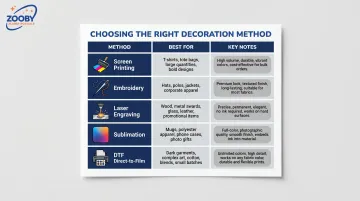
Choosing the wrong method creates real problems. Screen printing a complex multi-color logo on dark fabric, for example, often results in muddy reproduction and wasted spend. When catalog items and standard decoration methods can't meet client specifications, Zooby Promotional's global sourcing and custom manufacturing capabilities handle production to exact client requirements.
Logo Placement and Visibility
Decoration method sets the foundation — placement determines whether anyone actually sees the logo. A logo buried on the bottom of a bag or sized too small on a bottle achieves nothing. Effective placement follows the item's natural use:
- Front-center of a drinkware bottle or tumbler
- Chest or left-chest position on apparel
- Front panel of a tote or backpack
- Spine or cover of a notebook
Clean reproduction depends on clean files. Vector artwork (AI, EPS, or PDF formats) with Pantone color codes specified is the standard for accurate, sharp output. Reputable suppliers will request these files or help prepare them before production begins.
Brand Consistency Across Orders
Ordering multiple product types across different campaigns compounds inconsistency quickly. Slightly different blue tones on a mug versus a tote bag, or an outdated logo version on a batch of apparel, creates a fragmented brand impression.
Companies with ongoing merchandise programs should establish a brand standards document and work with a partner who actively manages color matching, logo versions, and design consistency across product types. Zooby Promotional's free Company Store solution supports this by centralizing branded merchandise in one managed platform, reducing the risk of off-brand products slipping through.
Planning Distribution and Fulfillment
Production and delivery logistics are the most frequently overlooked part of promotional campaigns. A well-selected, beautifully decorated product that arrives three days after your trade show is worthless.
Standard production timelines run 10–14 business days after artwork approval, with transit time added on top. For major events, holiday campaigns, or seasonal trade shows, plan for 4–6 weeks of total lead time. Rush options exist — some items can be expedited to 24–72 hours — but they come with surcharges and limited product availability.
For organizations managing ongoing campaigns, Zooby Promotional offers free Company Stores to all clients. These on-demand platforms let teams order branded items without purchasing, managing, or storing inventory. There's no bulk buying requirement, no warehouse overhead, and no risk of sitting on unsold stock.
That makes them especially useful for marketing teams running multiple campaigns or coordinating branded merchandise across distributed locations.
Measuring ROI post-distribution is worth building into your plan from the start:
- Set specific campaign goals before ordering (awareness, lead generation, employee engagement)
- Add QR codes or custom URLs to promotional materials for trackable digital connections
- Survey recipients after distribution to gauge product usefulness and brand recall
- Track whether campaign-specific traffic or conversions correlate with distribution timing
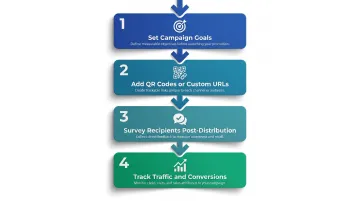
The more deliberately you track each campaign, the easier it becomes to justify — and optimize — your next order.
How Zooby Promotional Can Help
Since 2006, Zooby Promotional has helped brands across 40+ US states and three countries source, customize, and distribute promotional products that drive real brand visibility. Based in North Texas, the company pairs a global sourcing network with custom manufacturing capabilities — taking clients from initial concept through final delivery across every industry and budget range.
Key capabilities:
- Thousands of in-stock branded products across every major category — apparel, drinkware, bags, tech, office, awards, and more
- Custom manufacturing and global sourcing — produce virtually any product to exact specifications when catalog items won't do
- Free online Company Stores for on-demand ordering and fulfillment without inventory overhead
- Responsive, communicative service — trusted by clients including Microsoft, PETCO, Chase, Fairmont, TCU, and Comerica
- Experience across all organization types — from national corporations to schools, charities, and small businesses
Ready to find the right branded merchandise for your next campaign? Contact Zooby Promotional at sales@zooby-promotional.com to discuss your goals, audience, and budget.
Conclusion
The right custom promotional product starts with alignment — clear goals, a defined audience, a consistent brand identity, and a realistic distribution plan. Every factor covered in this guide points back to that same principle: make sure the investment generates impressions that hold, not items recipients forget within a week.
That alignment doesn't happen once — it compounds. Audiences shift, brand positioning evolves, and new product categories keep emerging. Marketers who track what worked, adjust what didn't, and refine their approach after each campaign make smarter choices and get stronger returns over time.
Frequently Asked Questions
What are the most effective types of custom promotional products for brand awareness?
Outerwear, bags, and apparel consistently generate the highest lifetime impressions (roughly 7,850, 5,772, and 5,053 respectively, per ASI research). The most effective product is always one that fits the recipient's daily life, not just general popularity rankings.
How much should I budget per item for custom promotional products?
Budget ranges vary widely: under $1 for pens and lanyards, up to $60+ for premium drinkware or apparel. The right metric is cost-per-impression, not unit price. A $20 insulated tumbler used daily for years typically delivers better ROI than a $1 giveaway that gets discarded within weeks.
How do I ensure my logo looks accurate on a custom promotional product?
Provide vector artwork files (AI, EPS, or PDF) and specify Pantone color codes. Select a decoration method suited to the product material and design complexity. Your supplier should review artwork before production begins and flag any reproduction issues.
How long does it take to produce custom promotional products?
Standard production typically runs 10–14 business days after artwork approval, plus transit time. For events, trade shows, or seasonal campaigns, plan for 4–6 weeks total lead time to avoid rush fees or availability issues.
What is the minimum order quantity for custom promotional products?
Minimums vary by product. Stock imprinted items often start at 25–100 units; fully custom-manufactured products may require higher quantities depending on the manufacturing process. A full-service partner can help identify options that fit both smaller and larger order needs.
Are eco-friendly promotional products worth the additional cost?
Yes, for most brands. Sustainable products tend to be kept longer, generate more impressions, and resonate with environmentally conscious consumers, particularly Gen Z. Stronger brand perception and a longer product lifespan offset the slightly higher per-unit cost.