Digital retention tactics — email sequences, retargeting ads, loyalty app notifications — have their place. But they share a fatal flaw: they're easy to ignore. Screens get scrolled past. Inboxes get filtered. Physical branded items don't.
A well-chosen promotional product sits on a customer's desk, rides in their bag, or gets used every morning with their coffee. It keeps your brand present between purchase cycles without requiring another ad dollar spent. That's a retention mechanic most businesses aren't fully exploiting.
Key Takeaways
- Acquiring new customers costs 5–25x more than keeping existing ones — retention ROI is hard to beat
- Physical branded items generate repeated brand impressions long after the initial gift, unlike digital ads that disappear instantly
- Emotionally connected customers deliver 306% higher lifetime value than merely satisfied ones
- The strongest retention products share three traits: daily utility, durability, and brand alignment
- Strategic gifting at onboarding, milestones, and loyalty touchpoints drives measurable retention gains
What Are Promotional Products for Customer Retention?
Promotional products are branded, tangible items given to customers with one purpose: reinforcing the relationship. When the goal shifts from "advertising" to "relationship reinforcement," the selection criteria change completely — from "what's cheapest?" to "what will this person actually use and value?"
These aren't just trade show giveaways. Effective retention-focused promotional products show up at specific moments across the customer lifecycle:
- New customer onboarding — a welcome kit that sets the tone for the relationship
- Loyalty milestones — a meaningful gift at 6 months or 1 year that signals the brand noticed
- Seasonal appreciation — holiday or anniversary sends that feel personal, not transactional
- Referral incentives — rewards that acknowledge a customer's advocacy with something tangible
- Post-purchase follow-up — a thank-you item that reinforces the decision to buy
Between purchase cycles — when a customer isn't actively engaging with your brand — a quality branded item keeps the connection alive. A well-chosen mug, bag, or notebook sits on a desk for months, providing repeated brand exposure that email campaigns and retargeting ads simply can't sustain.
Three Advantages That Actually Move Retention Metrics
Sustained Brand Recall That Outperforms Digital Advertising
A digital ad disappears after a scroll. A promotional product stays.
That staying power translates directly into brand impressions. A branded tumbler used five days a week generates hundreds of logo exposures per year from a single item, all without additional spend. According to ASI's Global Ad Impressions Study, drinkware is retained for an average of 12 months, bags for 11 months, and apparel for up to 14 months. Outerwear tops all categories at 6,100 lifetime impressions per item.
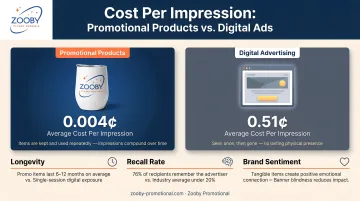
On cost-per-impression, promotional products deliver $0.006 per impression — lower than internet display ads ($0.007), prime-time TV ($0.018), and national magazines ($0.018).
Meanwhile, digital advertising faces a compounding problem:
- ~32% of internet users worldwide use ad blockers at least occasionally
- 67% of consumers report banner blindness — they simply don't see display ads anymore
- Ad fatigue is accelerating as ad volume increases across every platform
Promotional products bypass this entirely. They're opted-in, physical, and present in spaces where customers actually live and work.
KPIs this moves: unaided brand recall rate, cost-per-impression, customer lifetime value, repeat purchase interval
This advantage matters most in categories where customers shop infrequently: financial services, real estate, B2B services. In these markets, where staying top-of-mind between transactions is often the difference between winning and losing the next deal.
Emotional Loyalty Built Through Tangible Appreciation
An email discount code communicates one thing: here's an incentive to buy again. A physical, well-made branded gift communicates something different — that you were thinking about this specific customer, not just their next transaction.
That emotional distinction has measurable consequences. Research from Motista found that emotionally connected customers deliver 306% higher lifetime value compared to merely satisfied customers. They also stay with a brand for 5.1 years versus 3.4 years and recommend it at a rate of 71% versus 45%.
Promotional products create emotional connection through:
- Personalization — custom engravings, color preferences, or industry-relevant product choices signal that the brand understands who the customer is
- Quality signals — a well-made item reflects the brand's overall standards; a cheap item does the opposite, actively eroding trust
- Physical presence — unlike digital communications, a tangible gift occupies real space in a customer's life, triggering repeated positive associations
When a Comerica client or Microsoft employee receives a premium branded item, the finish and durability communicate something about the brand that gave it. Quality retention gifting reflects brand standards, not just brand logos.
This advantage peaks at key relationship moments: new customer onboarding, post-purchase follow-up, account anniversaries, and milestone celebrations.
KPIs this moves: Net Promoter Score, referral rate, customer satisfaction score, brand sentiment
Reciprocity That Converts Appreciation Into Repeat Purchases
Robert Cialdini's research on reciprocity is one of the most replicated findings in behavioral psychology: when someone receives a genuine, unexpected gift, they feel a natural inclination to return the gesture. In a business context, that reciprocity surfaces as repeat purchases, referrals, and deepened loyalty.
Cialdini's restaurant tipping studies put numbers to it. One unexpected mint at the end of a meal increased tips by 3%. Two mints increased tips by 14%. One mint, followed by a surprise return with a second "just for you" mint, increased tips by 23%. The personalization and unexpectedness amplified the effect significantly.
Businesses structure this through tiered gifting programs:
- Onboarding — a branded pen or tote bag that welcomes the new customer
- 6-month milestone — engraved drinkware or a premium notebook that marks the relationship
- 1-year anniversary — branded outerwear or a premium gift set that says this relationship matters
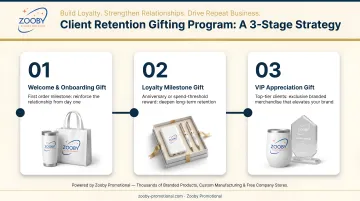
This approach creates escalating emotional investment on both sides. Contrast it with discount-based retention: discounts train customers to wait for deals. Gifts build affection that doesn't require a coupon to activate.
Reciprocity-driven gifting has its highest impact in B2B relationships and high-consideration consumer categories where trust and relationship depth directly influence the buying decision.
KPIs this moves: repurchase rate, average order value, loyalty program enrollment rate, referral conversion rate
What Happens When Promotional Products Are Skipped
Satisfied customers don't leave angry — they drift. Without consistent branded touchpoints, even loyal customers gradually lose top-of-mind awareness. When the next need arises, they go with whoever showed up most recently.
The compounding consequences of skipping promotional products:
- Brand invisibility between cycles — no physical reminder means no mental presence when the next purchase decision happens
- Price sensitivity creep — customers who feel underappreciated become easier to poach with a competitor's discount
- Lost referral pipeline — customers without an emotional bond rarely evangelize; organic, low-cost referrals dry up
- The recovery cost trap — the cost of winning back churned customers through acquisition campaigns far exceeds what a consistent retention gifting strategy would have cost
A 5% improvement in customer retention increases profits by 25% to 95%, per Bain & Company research. That means a modest promotional gifting budget needs to shift retention by only a few percentage points to deliver a measurable return — often several times the original spend.
How to Choose and Deploy Promotional Products for Maximum Retention Impact
The Three-Part Selection Framework
Not every branded item earns its place in a retention strategy. The strongest performers pass three tests:
- Relevance — does the item fit the customer's lifestyle or industry?
- Utility — will they use it daily or weekly?
- Quality — does it reflect the brand's actual standards?
Items passing all three generate the most impressions and the deepest brand affinity. PPAI research confirms that 80% of consumers keep promotional products because they are useful — attractiveness comes second. Utility is the primary predictor of retention duration.
Top-performing product categories for retention:
| Product | Why It Works | Avg. Retention |
|---|---|---|
| Insulated drinkware (tumblers, bottles) | Daily use, high-impression frequency | 12 months |
| Branded apparel (jackets, tees, hats) | High impression volume (up to 6,100 lifetime) | 10–14 months |
| Tote bags | 50% lift in business intent among recipients | 11 months |
| Power banks | High perceived value, frequent use | 12 months |
| Wireless chargers | Daily desk presence, strong utility | 12 months |
| Branded notebooks | Professional settings, desk visibility | 13 months |
| Premium pens | Most widely owned promo item (89% of consumers) | 9 months |
Strategic Deployment Touchpoints
One-time distribution is far less effective than a calendar-driven gifting cadence. The highest-impact moments:
- New customer welcome kit — sets the relationship tone immediately
- Post-purchase thank-you — reinforces the buying decision and reduces buyer's remorse
- 6-month or annual milestone — signals the brand is paying attention
- Seasonal appreciation send — holiday or anniversary gifts that feel personal
- Referral incentive — rewards advocacy with something tangible, not just a discount
Solving the Fulfillment Challenge
Managing product sourcing, inventory, and fulfillment across multiple customer segments is operationally complex — especially for teams running multiple gifting touchpoints simultaneously.
One solution worth considering: Zooby Promotional offers free Online Company Stores (Swag Stores) that let businesses distribute branded merchandise one item at a time — no bulk purchasing, no warehousing, no inventory management required. Fulfillment is handled on-demand, removing the operational overhead from the client entirely.
For businesses serving multiple customer tiers or geographic regions, this infrastructure makes segmented gifting — different items for different customer levels — practical without complexity. Zooby has supported clients including Microsoft, Comerica, Chase, and Lincoln Property Company, across categories ranging from executive gift sets to branded apparel and drinkware.
Conclusion
Promotional products earn their place in a retention strategy not through novelty, but through consistent presence. Each quality branded item is a physical extension of the relationship — keeping your brand alive between transactions without requiring another ad impression.
The three advantages — brand recall, emotional loyalty, and reciprocity — aren't independent. They compound. A customer who receives a thoughtful welcome kit, a milestone gift at six months, and a premium item at their one-year anniversary isn't just more likely to repurchase. They're more likely to refer, less sensitive to competitor pricing, and more forgiving when something goes wrong.
That's what a consistent gifting program builds over time. The structure matters less than the intent behind it. Start with one touchpoint — an onboarding gift or a six-month milestone item — and build from there. The compounding effect takes care of the rest.
Frequently Asked Questions
What are the top 10 most effective promotional products for customer retention?
Top performers include insulated drinkware, branded apparel, tote bags, power banks, wireless chargers, notebooks, pens, tech accessories, desk items, and premium seasonal gifts. The best choice depends on daily utility — what gets used regularly generates the most sustained impressions.
What are the 4 C's of customer loyalty?
Defined by Jennifer Rowley (2005), the four C's are Captive, Contented, Convenience-seeker, and Committed. Promotional products work best at building Committed loyalty (driven by emotional attachment) and nudging Contented customers toward deeper commitment before competitors step in.
How do promotional products compare to digital advertising for customer retention?
Digital ads offer targeting precision but face growing headwinds: roughly 32% of internet users now use ad blockers, and banner blindness affects the majority of remaining impressions. Branded physical items are kept for 9–14 months on average, generating ongoing impressions at a cost-per-impression of $0.006 — well below most digital channels.
How often should businesses give promotional products to customers?
At minimum: at onboarding, at a 6-month or annual milestone, and during seasonal appreciation windows. Consistency matters more than frequency. A predictable cadence builds relationship depth; irregular or one-time gifting can feel transactional rather than genuine.
What makes a promotional product high quality for retention purposes?
Quality for retention comes down to three things: durability (the item lasts), utility (the customer uses it regularly), and brand alignment (materials and finish reflect your standards). A cheap item signals the opposite of appreciation.
Can small businesses afford a promotional product retention strategy?
Promotional products scale with budget. Branded pens start around $0.58–$0.70 per unit; tote bags run $1.39–$2.19 per unit at minimum quantities. Even a modest investment in high-utility items for top customers almost always costs less than replacing a churned customer.