Introduction
Here's a number worth pausing on: only one in three U.S. workers strongly agree they received recognition or praise in the last seven days, according to Gallup. Meanwhile, employees who don't feel recognized are twice as likely to say they'll quit within the year.
The disconnect between how often managers think they recognize people and how often employees actually feel it is where turnover takes hold. Replacing those employees isn't cheap — Gallup estimates costs at up to 200% of annual salary for managers and 80% for technical roles.
The good news: fixing that gap doesn't require a big budget. It requires a consistent system. This guide covers 25 employee recognition award and program ideas across five categories — performance, teamwork, leadership, milestones, and culture — plus practical tips for making recognition actually stick.
Key Takeaways
- Most employees feel underrecognized — formal programs close the gap between manager intent and employee experience
- Effective recognition covers five categories: performance, teamwork, leadership, milestones, and culture
- Specific and timely recognition outperforms vague, delayed praise every time
- Peer-nominated awards add measurable impact beyond manager-only recognition
- Tangible, branded awards give milestone moments staying power — something employees keep, display, and remember
Why Employee Recognition Awards Matter
Employee recognition awards are formal or informal acknowledgments of an employee's contributions, behaviors, or milestones. The distinction between a program (ongoing, structured recognition built into company culture) and a one-time award (a single acknowledgment) matters in practice: programs build sustained engagement over time, while awards create individual moments of meaning. Both have a role, but programs work best as the foundation.
The data makes a compelling case. Employees who are well-recognized are 45% less likely to have turned over two years later, per Gallup-Workhuman research. Those same employees are four times as likely to be engaged and 73% less likely to report burnout.
And the cost of getting recognition wrong? Employee disengagement costs the global economy $8.8 trillion in lost productivity — roughly 9% of global GDP.
Those numbers point to one conclusion: recognition needs structure, not just good intentions. A well-rounded strategy operates across five building blocks:
The Five Categories a Complete Program Covers
- Performance & Achievement — recognizing results and above-and-beyond contributions
- Teamwork & Collaboration — acknowledging how employees work with others
- Leadership & Growth — celebrating people who develop themselves and others
- Milestones & Loyalty — honoring tenure and career moments
- Culture & Peer Recognition — reinforcing values and giving employees a voice in recognition
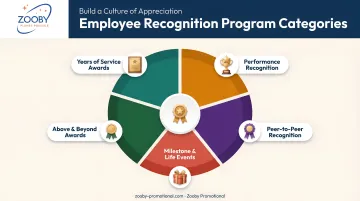
Each of the 25 ideas below falls into one of these five categories.
25 Employee Recognition Award & Program Ideas
These ideas are organized across five categories so companies can build a balanced program — not just a single annual event.
Performance & Achievement Awards
1. Top Performer Award / MVP Award Recognizes the employee who consistently exceeds targets and raises the bar. Works best when tied to quantifiable outcomes — sales numbers, project delivery, quality metrics — rather than general impression.
2. Going Above and Beyond Award For the employee who takes on more than their role requires — staying late to help a struggling colleague, volunteering for a difficult project, or solving a problem that wasn't theirs to solve. Reinforces the behaviors that hold teams together under pressure.
3. Innovation Award Honors employees who introduce new ideas, improve processes, or find smarter ways to work. Particularly valuable in organizations that need to adapt quickly — it signals that fresh thinking is welcome, not just tolerated.
4. Customer Service Award Recognizes exceptional client or customer interactions. Ideal for customer-facing teams, but also applicable to internal "customers" (other departments). Reinforces that the quality of every interaction reflects the company.
5. Most Goals Achieved Award A straightforward, data-driven award for the employee who hit the most individual targets in a given period. Its clarity is its strength — no subjectivity, no politics.
Performance awards land when they're tied to specific, measurable outcomes and given close to the achievement. Recognition that arrives three months after the fact loses most of its motivational power.
Teamwork & Collaboration Awards
6. Team Player Award Recognizes the employee who consistently makes the people around them better — sharing knowledge, covering gaps, staying solution-focused when things go sideways.
7. Cross-Department Collaboration Award For employees or small groups who bridge silos to accomplish something that required working across organizational lines. Especially meaningful in larger organizations where collaboration doesn't happen naturally.
8. Ripple Effect Award Named for the way one person's positive contributions spread outward. This award goes to someone whose impact — on morale, productivity, or culture — is felt beyond their immediate team.
9. Best Team Award Group recognition for a team that delivered something exceptional. Peer-level achievements deserve group-level celebration — individual awards in a collaborative outcome can feel divisive.
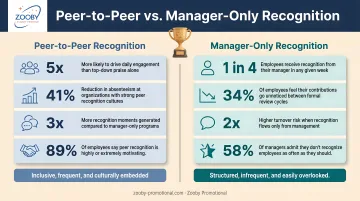
10. Peer-to-Peer Recognition Award Voted on by coworkers rather than managers. Peers notice day-to-day contributions that management often misses — and this award formalizes that observation into something meaningful.
Peer recognition deserves its own structured place in your program. Research from Harvard Business Review found that peer-to-peer recognition is 35.7% more likely to have a positive financial impact than manager-only recognition. It works differently — through frequency and breadth rather than weight — but the results are real.
Leadership & Growth Awards
11. Leadership Award Recognizes employees who demonstrate genuine leadership qualities — clarity of direction, team development, accountability. Can apply to formal managers or informal leaders equally.
12. Coaching Champion Award For employees who actively develop others: the ones who make time to answer questions, walk teammates through problems, and invest in the success of the people around them.
13. Mentorship Award Similar to the coaching award, but focused on longer-term relationships and career development. Honors employees who take on mentorship roles — whether formal or informal — and actually follow through.
14. Rising Star Award For early-career employees who are already showing outsized potential. Signals that the company is paying attention and investing in their future — which goes a long way toward retention.
15. Most Improved Award Recognizes measurable growth over time, not just current performance level. Valuable because it rewards effort and trajectory — not just people who started with an advantage.
Leadership awards should not be limited to people with formal titles. Some of the most influential people in any organization never appear on an org chart. Including informal leaders and mentors in this category sends a signal that matters: your company promotes leadership as a practice, not a position — and that shapes how the next generation of leaders develops.
Milestones & Loyalty Awards
16. Years of Service Award The classic — recognized at 5, 10, 15, and 20+ year marks. Works best when it feels genuinely personal rather than like a checkbox exercise. A generic certificate rarely does the moment justice.
17. Work Anniversary Award Annual recognition of each employee's hire date. Even a one-year acknowledgment matters — it reinforces that the employee's decision to join (and stay) is noticed.
18. Retirement Award ("Leaving a Legacy" Award) A career-closing recognition that honors the full arc of someone's contribution. Should feel as significant as the milestone actually is — this is not the moment for a gift card.
19. Loyalty Award Distinct from a years-of-service award in that it focuses on impact over time, not just tenure. For the employee who has shaped the company's direction, culture, or capability across years of commitment.
20. New Employee Welcome Award For the standout new hire who brings energy, skills, or attitude that immediately raises the bar. Recognizes exceptional onboarding performance and signals that new voices are genuinely valued.
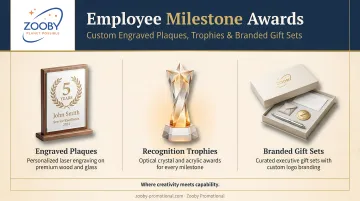
Milestone awards should feel personal — not like an administrative event. Pairing them with a custom-branded item (an engraved plaque, a curated gift set, or a quality trophy) transforms a date on the calendar into a moment worth remembering. Zooby Promotional's awards and recognition catalog — spanning acrylic trophies, wood plaques, perpetual awards, and executive gift sets with laser engraving and custom messaging — is built for exactly this kind of program.
Fun, Peer & Culture Awards
21. Company Values Award Goes to the employee who embodies the company's stated values in how they actually work — not just in how they talk about it. Directly reinforces what the organization says it stands for.
22. Spotlight Award For standout work that doesn't always make it to the manager's radar. Think: the person who quietly solved a recurring problem, or whose behind-the-scenes contributions made a big project possible.
23. People's Choice Award Voted on by the entire company. Broad participation creates broader investment in the outcome — and it often surfaces names that wouldn't appear on a manager-generated list.
24. Recognition Master Award For employees who consistently recognize and appreciate others. This one is worth adding to any program: it rewards the behavior of recognition itself, which helps embed it into your culture.
25. The Lighthouse Award For the person who consistently guides the team through uncertainty — the go-to problem-solver who others orient around when things get complicated. (Swap this for whatever fits your company's voice: "The Energizer Award" for the person who lifts morale, or "The Mountain Mover Award" for the one who pushes through obstacles others avoid.)
Culture awards serve a dual purpose. They celebrate the recipient and signal to everyone else which behaviors and attitudes the organization actually values. When done well, recognition becomes self-reinforcing — employees see what gets noticed, and they start modeling it.
Tips for Running a Recognition Program That Actually Works
Make It Specific and Timely
Specific recognition names the behavior, connects it to a real outcome, and makes the employee feel seen — not just appreciated in the abstract. Vague praise doesn't do that.
Compare these two:
- ❌ "Great work on the Henderson project."
- ✅ "You caught the billing discrepancy that would have cost us the Henderson account. That attention to detail saved a $200K relationship."
Specificity only works when the timing is right. Recognition given the same week as the achievement reinforces the behavior while it's still fresh. Recognition given three months later signals the opposite — that the moment passed without anyone noticing.
Make It Inclusive and Consistent
Only 26% of employees strongly agree they receive similar recognition as others for similar performance. That number signals a structural problem, not a personality one. When the same five names win every quarter, or when frontline and remote employees are invisible to the program, recognition stops feeling fair — and fair recognition is a prerequisite for effective recognition.
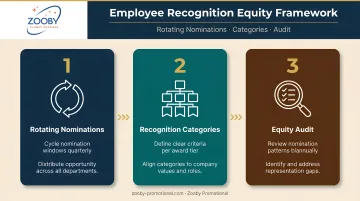
Three ways to build equity into your program:
- Rotate award nomination responsibility across managers and departments, not just senior leaders
- Create category-specific awards that give different roles a realistic path to recognition
- Audit your award history annually — if the same people keep winning, the program has a design flaw
Tie Awards to Company Values
Recognition programs that connect awards to stated values reinforce what the company actually stands for — and that clarity compounds over time. According to O.C. Tanner, 84% of employees say recognition has a direct impact on morale and motivation, and that impact increases when recognition is tied to purpose.
The practical approach: review your company's value statements and map each award category to one or two of them explicitly. If your values include "customer obsession," your Customer Service Award should reference that value in its criteria and presentation. Done consistently, this turns individual awards into a visible, ongoing signal of what your organization actually rewards.
Conclusion
A recognition program doesn't need a big budget or a dedicated HR platform to work. It needs three things: intention, consistency, and personal specificity. Programs that check those boxes — even modest ones — consistently outperform elaborate programs that feel generic or arbitrary.
For companies that want to add something tangible to their recognition moments, Zooby Promotional offers branded recognition products built for programs of every size:
- Custom trophies and award plaques
- Engraved items and premium acrylic awards
- Bundled gift sets for milestones and tenure recognition
- Executive gifts and branded merchandise packages
Zooby handles the sourcing, imprinting, and fulfillment — so each recognition moment lands with the weight it deserves.
Reach out at sales@zooby-promotional.com to discuss your program's needs.
Frequently Asked Questions
What are good employee recognition ideas?
Good ideas range from peer shoutouts and custom trophies to milestone celebrations and company-wide People's Choice votes. The best choice depends on your culture and the recipient — some employees value public acknowledgment, others prefer a private note paired with something tangible.
What are the 4 types of recognition in the workplace?
The four common types are formal recognition (structured awards programs), informal recognition (spontaneous praise), peer-to-peer recognition, and manager-to-employee recognition. Formal works best for milestones, informal for daily wins, peer-to-peer for collaboration, and manager-led for performance reviews.
What are some categories for awards?
The main categories are performance and achievement, teamwork and collaboration, leadership and growth, milestones and service, and culture and peer recognition. Using multiple categories ensures that employees across different roles and working styles have a realistic path to being recognized.
What should I write in an employee recognition award message?
Be specific: name what the employee did, explain why it mattered, and describe the impact on the team or company. Avoid generic language — a message that could apply to anyone effectively applies to no one. Keep the tone warm and direct.
What is a good name for an employee recognition program?
Some examples: Champions Circle, Spotlight Program, Above & Beyond Awards, The Pinnacle Program, The Apex Awards. The best name reflects your company's brand voice — something formal works for a financial firm; something energetic works for a startup.
What are some creative award names?
Creative names make awards more memorable: The Lighthouse Award, Ripple Effect Award, Rising Star Award, Mountain Mover Award, Cloud 9 Collaborator, The Energizer Award, Above & Beyond Badge, The Compass Award. The strongest names connect directly to the behavior or value being celebrated, making the award feel earned rather than generic.