That gap between a forgettable giveaway and something people actually keep comes down to customization strategy: the technique you choose, where the branding lives, and whether the approach matches both the product and the person receiving it.
This guide covers the five most effective customization techniques, how to match them to your audience and budget, logo placement principles that actually work, and the mistakes that consistently sink otherwise solid gifting programs.
Key Takeaways
- Technique selection matters as much as the gift itself — match the method (screen printing, embroidery, engraving) to the product and budget
- Subtle, tonal, or engraved branding consistently outperforms large logo application in perceived value and public use
- Know your recipient: employees, clients, and event attendees have different branding tolerances, and the approach should follow the audience
- Premium base products can carry more visible customization without feeling promotional
- Custom packaging creates an unboxing experience that elevates the gift without changing the product itself
Why Customization Elevates Corporate Promotional Gifts
There's a meaningful difference between a branded item and a customized gift. A branded item carries your logo. A customized gift carries intent — the right product, the right technique, the right placement, chosen with the recipient in mind.
Recipients feel that distinction — even if they can't articulate it.
PPAI research found that 48.7% of consumers keep promotional products for more than five years, and 75.4% cite usefulness as the primary reason. Quality and sentimental connection follow. Logo size doesn't make the list.
The items that stick around earn their place — functional, well-made, branded in a way that doesn't undermine the product's appeal. PPAI's Product Power 2026 study confirmed this, finding that consumers associate branded merchandise with "personal relevance, design appeal, and emotional connection." They respond to thoughtful, functional products rather than mass giveaways.
That consumer behavior translates directly into business outcomes:
- Daily-use items generate consistent brand recall at a fraction of the cost of traditional advertising
- Employee onboarding kits with well-designed customization build belonging and reinforce culture from day one
- Premium client gifts with restrained branding reinforce the relationship without feeling like a sales pitch
Customization quality is what determines which category your gift actually falls into.
Top Customization Techniques for Corporate Promotional Gifts
Choosing the right technique before selecting a product prevents the most common and costly customization errors. Each method has a natural home — in terms of material, aesthetic, volume, and budget.
Screen Printing
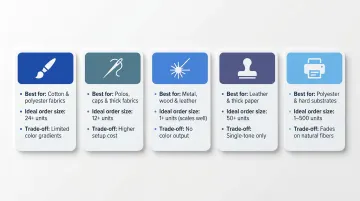
Screen printing is the industry standard for flat-surface items at volume: t-shirts, tote bags, mouse pads, and event giveaways. It supports 1 to 6 spot colors with Pantone matching and specialty finishes including metallic and reflective inks.
Best suited for:
- Orders of 24+ pieces
- Simple, bold artwork with defined color separations
- High-volume event merchandise where cost efficiency matters most
The per-color setup cost means screen printing rewards volume. It's less economical for short runs or complex artwork — that's where digital printing takes over.
Embroidery
Embroidery is the default for apparel and headwear when a premium, tactile finish matters: polos, fleeces, structured caps, and quality bags. The dimensional texture reads as craftsmanship in a way no other technique does on fabric.
Pricing is driven by stitch count. A standard left-chest logo runs 3,000–5,000 stitches; a medium front logo runs 6,000–9,000 stitches. Complex or detailed artwork can exceed 12,000 stitches and increase cost proportionally.
One practical constraint: embroidery doesn't reproduce gradients or fine detail well. It works best with clean, bold marks — not intricate illustrations or small type.
Laser Engraving
Laser engraving creates a permanent, ink-free mark on metal, leather, wood, and powder-coated surfaces. For drinkware, tech accessories, and executive gifts, it's the premium choice. The branding feels integrated into the product rather than applied to it.
Key characteristics:
- Single-color, high-contrast result — no full-color output
- Lasts the entire lifespan of the item — no fading, cracking, or peeling
- Raises perceived value noticeably on high-end items
A $60 engraved tumbler stops reading as a promotional item — it reads as a deliberate choice.
Debossing and Embossing
Both techniques use heated metal dies pressed into a substrate to create a permanent, tactile impression. Debossing creates a recessed mark; embossing creates a raised one.
| Attribute | Debossing | Embossing |
|---|---|---|
| Best materials | Leather, vinyl, padfolios | Paper, cardstock, stationery |
| Aesthetic | Subtle, understated | More dimensional, visible |
| Best for | Minimalist brand aesthetics | Simpler, less-textured surfaces |
Zooby's catalog includes a range of leatherette journals, padfolios, and executive portfolios that pair well with both techniques — the Amherst Leatherette Journal and New Age Italian PU Leather Padfolio among them.
Full-Color Digital and Dye-Sublimation Printing
Digital printing covers two related but distinct methods:
- DTG/DTF printing: No setup fees, unlimited colors, economical for runs under 24 pieces — ideal for custom socks, phone cases, and short-run branded notebooks
- Dye sublimation: Requires 65%+ polyester content; produces edge-to-edge, seam-to-seam prints that become part of the fabric — permanent, no cracking or peeling
Digital printing excels for visually complex artwork and short runs. The trade-off on some surfaces is durability under heavy handling, so it works best where visual impact is the priority.
Custom Packaging and Presentation
Packaging is often the most underused customization layer. Branded boxes, tissue, inserts, and thank-you cards shape the entire experience before the recipient even sees the product.
This matters for a few reasons:
- The unboxing moment now functions as part of the gift itself
- Packaging can carry brand identity without putting a large logo on the product
- It drives social sharing and emotional response in ways product branding alone can't
Zooby offers custom packaging as an add-on across product categories — branded gift boxes, header cards, and specialty sleeves — so orders ship as a complete gifting experience, not just a branded product.
How to Match Customization to Your Audience, Product, and Budget
Start With the Recipient
Audience type should drive technique selection before product selection begins:
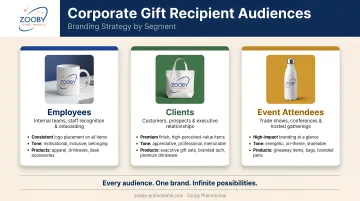
- Employees value quality and belonging — embroidery on good apparel, or a well-packaged onboarding kit, signals investment in them
- Clients value subtlety and premium feel — laser engraving or debossed leather goods communicate relationship, not promotion
- Event attendees prioritize utility and portability — screen printing on tote bags or drinkware at volume is appropriate and cost-effective
Match Technique to Product Category
| Product Type | Recommended Technique |
|---|---|
| Soft goods (apparel, bags) | Embroidery or screen printing |
| Hard goods (drinkware, tech, accessories) | Laser engraving |
| Leather and soft-goods accessories | Debossing |
| Paper, notebooks, packaging | Digital printing or debossing |
Confirm technique compatibility with your supplier before finalizing artwork. Some products aren't suitable for every method, and mismatches cause the most common production problems.
Logo Placement Principles
For premium gifts, place branding in secondary, understated locations: bottom hem, inner collar, or side panel. Tonal application — matching logo color to product color — makes recipients far more likely to wear or carry the item publicly.
Functional giveaways follow a different logic. A $3 pen at a trade show doesn't need subtle branding — visibility is the point, and prominent placement delivers it.
Budget-Tier Framework
Customization spend should scale with recipient tier. Published benchmarks put U.S. corporate gift spending at $50–$100 per standard client, $100–$250 per key client, and $250–$500+ per VIP. Technique sophistication should follow the same ladder:
- Screen printing: Cost drops sharply at volume — ideal when you're ordering 250+ units and per-unit spend needs to stay under $5
- Embroidery: Holds up through repeated washing, making it the right call for apparel that employees will actually wear long-term
- Laser engraving / debossing: No ink, no fading — appropriate when the gift itself needs to last as long as the relationship
Fewer, better-customized items consistently outperform large quantities of poorly branded ones — both in recipient retention and brand perception.
Where a Full-Service Partner Adds Value
Managing customization across multiple techniques, products, and recipient groups gets complicated fast. Zooby Promotional handles that complexity directly: sourcing from a global partner network, coordinating customization across techniques and product categories, and distributing everything through their free Company Stores platform. For teams managing branded merchandise across multiple departments or recipient types, consolidating it with one partner removes significant overhead and keeps brand standards consistent.
Common Customization Mistakes to Avoid
Mistake 1: Over-branding the product
An oversized, high-contrast logo on a premium or lifestyle gift immediately reads as promotional collateral. Recipients are significantly less likely to use over-branded items publicly — which defeats the purpose. Industry sources are consistent: aggressive branding "can damage a brand's image by appearing desperate for attention or lacking sophistication." Keep the logo tasteful and appropriately sized for the product.
Mistake 2: Mismatching technique to product
Screen printing on curved drinkware, embroidery on thin or smooth fabric, gradient artwork requested for embroidery — these mismatches produce poor results that reflect badly on the brand. Always verify technique compatibility with your supplier's production capabilities before committing to artwork.
Mistake 3: Ignoring artwork quality
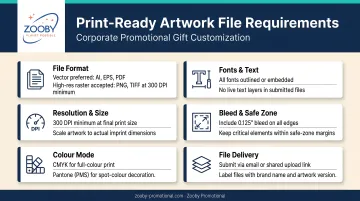
Always submit print-ready files that meet these standards:
- Vector files (AI, EPS, or PDF) at 300 DPI minimum
- CMYK color mode for full-color printing
- Pantone codes for brand-critical color matching
- Fonts converted to outlines to prevent substitution errors
Request a digital proof before approving production — or a physical sample on large orders. Catching a color mismatch or font issue at proof stage costs nothing; catching it after 500 units are printed is a different story.
Conclusion
The gift category matters, but customization strategy is what determines whether a corporate promotional gift builds real brand equity or ends up forgotten. Technique selection, logo placement, audience alignment, and product quality aren't afterthoughts — they're the difference between gifts people keep for years and items discarded in weeks.
For organizations ready to approach branded merchandise more strategically, Zooby Promotional handles everything from sourcing and imprinting to manufacturing and fulfillment, including free Company Stores that simplify ordering for teams of any size. Email sales@zooby-promotional.com to get a quote or discuss your next branded merchandise project.
Frequently Asked Questions
What is a good custom corporate gift?
A good corporate gift combines a high-quality, genuinely useful product with restrained, intentional branding — keeping function and appearance ahead of logo prominence. The best gifts reflect the recipient's role or relationship with the company, rather than defaulting to whatever's convenient or cheapest.
What are the latest trends in corporate gifting?
The dominant trends for 2025–2026 are sustainability and eco-conscious materials, minimalist retail-quality aesthetics, premium unboxing presentation, and hybrid work essentials. There's also a clear shift away from traditional screen-printed logos toward subtle tonal, engraved, or debossed branding on premium items.
What promotional products are most effective?
ASI's 2026 Ad Impressions Study confirms drinkware, apparel, and bags generate the most impressions over time due to daily use. Effectiveness increases sharply when items are high-quality and customized for the recipient — a $6 tote bag can deliver approximately 5,000 lifetime impressions when people actually use it.
What are top sustainable corporate promotional gift options?
Strong sustainable options include recycled-material tote bags, FSC-certified bamboo notebooks, organic cotton apparel, and stainless steel drinkware. Water-based inks for screen printing further reduce environmental impact. Certifications like GOTS (organic textiles) and FSC (paper and wood) provide third-party verification — all categories Zooby Promotional carries.
What is the etiquette for giving corporate gifts?
Check the recipient's company gifting policy before giving, particularly in regulated industries. Keep branding subtle on gifts intended to feel personal. Timing and occasion matter — a well-timed gift reinforces a relationship, while a poorly timed one can feel transactional. Avoid luxury gifts that may feel inappropriate given the business relationship.
What is the difference between a promotional item and a gift?
Promotional items are primarily brand-awareness tools distributed broadly — trade shows, events — with visible branding and a focus on impressions. Corporate gifts are relationship-focused, typically higher quality, and benefit from more subtle or personalized customization. The line between the two has narrowed as premium branded merchandise now serves both purposes effectively.