Introduction
A logo-engraved tumbler lands on an executive's desk. A well-embroidered jacket gets worn to a weekend game. Each use is an impression — and according to PPAI's Product Power 2026 study, 90% of consumers say receiving branded merchandise improves their perception of the brand. It's a near-universal response — but only when the gift is made well.
The challenge is matching the right tool to the right gift. Businesses face options across five distinct categories: design software, laser engravers, sublimation printers, embroidery machines, and full-service suppliers. Each serves a different substrate, scale, and budget — and the wrong choice produces results that hurt rather than help brand perception.
That selection process is harder than it looks. 67% of all print production errors trace back to prepress issues (wrong color modes, missing fonts, incorrect file formats) before a single item is produced.
This guide covers what you need to make a confident decision:
- The five most important tool categories for branded corporate gifts and who each suits best
- How each category handles different substrates, order volumes, and production setups
- A practical framework for choosing based on your gift type, budget, and in-house capabilities
Key Takeaways
- Design software (Adobe Illustrator, CorelDRAW) prevents costly errors by generating print-ready vector files before production starts
- Laser engravers deliver permanent branding on hard goods — leather, wood, metal, glass — ideal for executive gifts
- Sublimation printers produce full-color, photographic-quality designs on polyester apparel and polymer-coated drinkware
- Embroidery machines are the standard for branded fabric gifts — durable, tactile, and longer-lasting than screen printing
- Skip the equipment entirely — full-service suppliers handle sourcing, imprinting, and shipping so you don't have to
Why the Right Tools Matter for Branded Corporate Gifts
A branded gift is any item carrying a company logo, color palette, or tagline — applied through printing, engraving, embroidery, or sublimation. Done well, it becomes a lasting brand touchpoint. Done poorly, it becomes clutter.
Quality is what determines which outcome occurs. ASI's Global Ad Impressions Study found that 52% of recipients keep promotional products specifically because of quality — and outerwear averages 16 months of retention. A well-made jacket generates roughly 6,100 lifetime impressions. A cheap one gets donated or thrown away.
The business math is unforgiving: a poor-quality gift burns the budget and damages brand perception at the same time.
How Tool Choice Affects Large-Scale Orders
Tools that produce acceptable results at 10 units often fail at 1,000. Color consistency drifts, embroidery tension varies, and engraving depth becomes unpredictable as volume climbs. The right tool must perform reliably across both small runs and large campaigns. At scale, inconsistency isn't just a quality issue — some recipients get a great impression while others receive a defective product representing your brand.
The Best Tools for Creating Branded Corporate Gifts
This guide covers five tool categories selected for versatility, branding output quality, scalability, and accessibility, ranging from small in-house setups to fully outsourced programs.
Logo Design and Digital Proofing Software
Every branded gift starts digitally. Design software — Adobe Illustrator, CorelDRAW, Canva — creates the artwork. Proofing tools — Adobe Photoshop, Figma — let teams visualize how a logo will appear on a specific product before any item is made.
The output format determines whether everything downstream works correctly. Promotional vendors require vector files because they scale infinitely without quality loss. Raster files (JPG, PNG) cannot.
Four non-negotiable file requirements:
- Submit vector formats only (.AI, .EPS, .PDF) — raster images pixelate when scaled for production
- Convert all text to outlines — prevents font substitution when files open on a different system
- Use Pantone (PMS) spot colors for exact brand matching, or CMYK for full-color process printing
- Never submit RGB files — RGB shifts unpredictably when converted for physical printing
The 67% prepress error statistic cited above is a direct consequence of skipping these steps. Most production errors start here, not on the equipment.
| Category | Details |
|---|---|
| Best For | Creating print-ready artwork, generating vector files, approving designs before bulk orders |
| Key Considerations | Adobe requires a subscription; Canva works for simple designs but has limits for complex print work; always export in the format your vendor specifies |
Laser Engraving and Cutting Machines
Laser engravers etch logos and text directly into material surfaces (leather, wood, metal, acrylic, glass), producing a finish that does not fade, peel, or wear off. For executive gifts and premium hard goods, this is the highest-perceived-value decoration method available.
CO2 vs. Fiber lasers — the distinction matters:
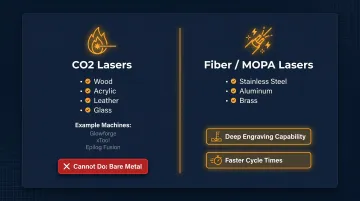
- CO2 lasers (Glowforge, xTool, Epilog Fusion) excel on organic materials: wood, acrylic, leather, glass. They cannot engrave bare metal directly.
- Fiber/MOPA lasers specialize in metals — stainless steel, aluminum, brass — with deep engraving capability and faster cycle times on hard surfaces.
Equipment cost ranges:
| Tier | Examples | Approximate Price |
|---|---|---|
| Entry-level desktop | xTool D1 Pro (refurbished), Glowforge Pro (rebuilt) | $650 – $2,999 |
| Mid-range professional CO2 | Epilog Fusion Ascent 12 (30-60W) | $8,995 – $13,995+ |
| Industrial fiber/MOPA | 20-60W desktop fiber systems | $2,000 – $10,000+ |
One often-overlooked requirement: laser engraving produces fumes that require either external ventilation or a dedicated extraction unit. Glowforge sells a proprietary filter at $1,295 as an alternative to ductwork, which should be factored into total setup budgets.
| Category | Details |
|---|---|
| Best For | Leather journals, wooden products, metal tumblers, glass awards, tech accessories, keychains, award plaques |
| Key Considerations | Upfront equipment cost is significant; requires design software integration; mandatory ventilation; material calibration takes time to master |
Sublimation Printers and Heat Press Machines
Sublimation printing bonds dye with material at a molecular level, producing photographic-quality designs with no cracking or peeling. The Sawgrass SG500 starts at approximately $624, making it one of the more accessible entry points for in-house production. A basic heat press (ProWorld Clam Basic) adds roughly $499 to the setup.
Heat press machines also enable heat transfer vinyl (HTV) applications on t-shirts, caps, tote bags, and jackets, extending their usefulness beyond sublimation alone.
Critical material constraints — these are non-negotiable:
- Sublimation only works on 100% polyester fabrics or polymer-coated substrates
- Bases must be white or light-colored — sublimation inks are translucent and won't reproduce accurately on dark materials
- 100% cotton and dark fabrics are incompatible with standard sublimation; using them wastes materials regardless of technique
Sawgrass announced permanent lower pricing in May 2026, specifically targeting shops running consistent daily production, suggesting that daily output volume is the threshold at which in-house sublimation becomes cost-justified.
| Category | Details |
|---|---|
| Best For | Drinkware, branded apparel, caps, tote bags, mouse pads, and any polymer-coated promotional product |
| Key Considerations | Requires sublimation-specific ink and paper; heat press needs consistent temperature calibration; substrate must meet polyester or coating requirements |
Embroidery Machines
Embroidery is the premium standard for fabric gifts. Machines like the Brother PE800 apply logos to polo shirts, jackets, hats, tote bags, and branded blankets through durable 3D stitching that screen printing and iron-on transfers cannot replicate. The tactile finish is immediately noticeable, which is why embroidery is the default choice for executive-level and client-facing apparel gifts.
Equipment cost ranges:
- Entry-level (Brother SE700, single-needle): Consumer-grade pricing, suitable for low-volume production
- Commercial multi-head (Tajima, Barudan, SWF): Commercial machines requiring direct manufacturer quotes — pricing reflects volume capability
The digitizing requirement most buyers miss:
Embroidery machines cannot read standard image files. Artwork must be converted into stitch-path files (.DST or .PES formats) through a process called digitizing. Without it, production fails.
| Logo Complexity | Approximate Digitizing Cost |
|---|---|
| Simple (text, basic shapes — left chest, cap) | $10 – $25 |
| Medium (detailed logo, multi-color — polo front) | $20 – $50 |
| Complex (photographic, large-scale — jacket back) | $50 – $150+ |
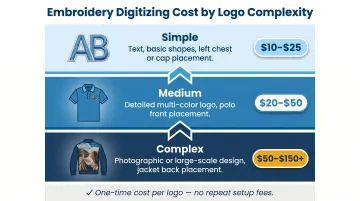
Digitizing is a one-time cost per logo. Once the file exists, reproducing the same design at any scale adds no additional setup expense, which makes embroidery economically attractive for recurring, high-volume programs.
| Category | Details |
|---|---|
| Best For | Polos, jackets, hats, tote bags, and branded apparel for employee recognition or client gifting |
| Key Considerations | Higher upfront digitizing cost; not suited for complex photographic designs; works best for clean logos with limited color counts |
Full-Service Promotional Suppliers
For businesses without in-house equipment, full-service suppliers handle sourcing, design support, production, and shipping under one roof. The U.S. promotional products industry hit $27.1 billion in 2025 (PPAI), with online sales reaching $7.1 billion — 26.3% of total volume. This isn't a niche channel; it's now a primary one.
When outsourcing makes more sense than buying equipment:
- Order volumes are variable or seasonal (holiday gifting, annual events, trade shows)
- The gift program spans multiple product categories requiring different decoration methods
- Staff aren't available to operate and maintain production equipment
- Design support and digital proofing before production are needed without internal design resources
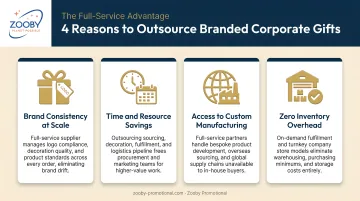
Quality varies substantially between budget platforms and full-service suppliers. When evaluating vendors, look for QCA certification (the promotional products industry's quality and compliance body) and CPSC compliance, particularly for products that may be used by children or in regulated environments.
Zooby Promotional is an example of what a full-service partner looks like in practice. Founded in 2006 and headquartered in Dallas, Zooby serves clients across over 40 states, including national brands like Microsoft, PETCO, Chase, Comerica, and Lincoln Property Company, as well as universities, nonprofits, and regional organizations. Their catalog covers apparel, drinkware, tech accessories, bags, and office supplies, with decoration capabilities including screen printing, embroidery, sublimation, pad printing, and full-color digital printing.
One standout offering is their free Company Store solution — a hosted online swag store that lets businesses distribute branded merchandise one item at a time without purchasing, managing, or storing inventory. It's particularly useful for organizations that need ongoing branded merchandise access without committing to bulk orders or warehousing costs.
How to Choose the Right Tool for Your Corporate Gifting Program
Start with Gift Type and Material
The substrate you're decorating determines which tools can do the job — so start here before evaluating anything else.
| Material / Substrate | Best Tool |
|---|---|
| Wood, leather, acrylic, glass | CO2 laser engraver |
| Stainless steel, aluminum, brass | Fiber/MOPA laser engraver |
| Polyester apparel, polymer-coated drinkware | Sublimation printer + heat press |
| Structured apparel (polos, jackets, hats) | Embroidery machine |
| Mixed categories, diverse product needs | Full-service supplier |
Factor In Order Volume and Frequency
In-house equipment only makes economic sense for organizations producing branded gifts regularly and in consistent quantities.
- Low or variable volume (under 500 units per quarter, seasonal campaigns): Outsource — avoid capital costs and idle equipment
- Medium, growing volume: Run a break-even analysis against per-unit supplier costs
- High recurring volume with daily production: In-house investment becomes justifiable
One-time campaigns, holiday programs, and varied assortments almost always favor outsourcing.
Match Branding Complexity to the Right Method
A simple one-color logo on a tote bag has different requirements than a photographic print on a mug.
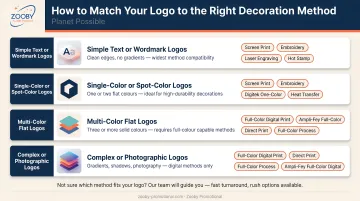
- 1-2 color logos → screen printing, laser engraving, or embroidery
- Full-color photographic designs → sublimation or digital printing
- Premium tactile finish → embroidery delivers the highest perceived value
- Permanent, wear-resistant branding → laser engraving or embroidery outlast printed methods
Account for Total Cost of Ownership
Equipment sticker prices understate actual costs. A mid-sized in-house setup also carries:
- Consumables (sublimation ink and paper, embroidery thread and backing, laser tubes and lenses)
- Maintenance contracts and periodic repairs
- Facility space and ventilation infrastructure
- Dedicated labor (operating, calibrating, troubleshooting)
Outsourcing converts all of those fixed costs into variable per-unit spend. Your budget scales with actual order volume, and no capital sits idle between campaigns.
Conclusion
Branded corporate gifts are only as effective as the execution behind them. The right tool ensures a logo lands correctly on the right product at the right scale. That holds true whether you're ordering 15 engraved leather portfolios for a board retreat or 2,000 embroidered polos for an employee recognition program.
The choice between in-house equipment and a full-service partner comes down to volume, variety, and frequency. Both paths can work — what matters is that quality doesn't get sacrificed when budgets tighten.
For businesses that want professional-quality branded gifts without managing equipment, inventory, or fulfillment logistics, Zooby Promotional has been helping organizations across 40+ US states since 2006. Their services include:
- Custom sourcing and imprinting across thousands of products
- Fully custom manufacturing tailored to exact specifications
- Free Company Store setup for seamless branded merchandise distribution
- Clients ranging from local nonprofits and schools to Microsoft, PETCO, and Chase
Reach out at sales@zooby-promotional.com to explore options.
Frequently Asked Questions
What are good custom-branded high-end corporate gift ideas?
Laser-engraved leather journals, custom tumblers from recognized drinkware brands, embroidered executive jackets, and curated gift sets combining tech accessories (wireless chargers, earbuds) with branded packaging all perform well at the premium tier. High-end branded gifts work best when the product itself is something the recipient would buy — the logo is secondary to the quality.
What is the etiquette for corporate gifting — are there value limits or common rules?
Many organizations set compliance-driven gift value limits, often $25–$75 per recipient for clients and higher for employees. Note that the IRS limits the business gift deduction to $25 per person per year. Branded items are generally more appropriate than cash-equivalent gifts in a business context — they feel appreciative rather than transactional.
What file format should I submit when ordering branded corporate gifts?
Vector formats — .AI, .EPS, or .PDF — are the standard requirement. Raster files (JPG, PNG) lose quality when scaled for production and don't support clean color separation. Always confirm your Pantone or CMYK color codes with the supplier before submitting to ensure brand color accuracy.
How far in advance should I order branded corporate gifts?
Plan for 4–6 weeks on standard custom orders to cover design approval, production, and shipping. For Q4 holiday programs, start by September — production largely shuts down in late December, and carrier delays make last-minute orders a serious risk.
What is the best branding method for premium executive gifts?
Laser engraving (for hard goods — leather, metal, wood) and embroidery (for structured apparel) deliver the highest perceived quality. Both are permanent and tactile: they don't fade, crack, or peel, which is what separates an executive gift from a standard giveaway.
Can I get branded corporate gifts without minimum order quantities?
Some suppliers offer low-minimum or no-minimum options, though per-unit costs rise at lower quantities. Zooby Promotional's Company Store model distributes items one at a time without bulk order requirements — but minimums vary by product category, so confirm specifics and any setup fees before ordering.