Introduction
Most managers believe they're doing enough to make employees feel appreciated. Most employees disagree. That gap — between leadership's intentions and employees' actual experience — is precisely why structured recognition programs exist.
The numbers are hard to ignore: only about 1 in 4 employees feel valued at work, according to recent Workhuman research. Meanwhile, voluntary turnover costs U.S. businesses an estimated $1 trillion annually. Recognition programs consistently rank among the most cost-effective retention tools a company can deploy.
This guide covers what an employee recognition program actually is, how to build one step by step, which recognition ideas move the needle on morale, and the mistakes most companies keep making. Whether you're starting from scratch or fixing a broken program, you'll leave with a concrete plan you can act on.
Key Takeaways
- Recognized employees are 45% less likely to leave their organization within two years — making recognition a direct retention lever.
- Effective recognition is timely, specific, and consistent — not a once-a-year gesture.
- Strong programs combine formal, informal, and everyday recognition from both managers and peers.
- Pairing tangible rewards — branded merchandise, awards, or curated gift kits — with public acknowledgment reinforces the behavior you want repeated.
- Avoid generic praise, top-down-only structures, and programs that leave out remote or hourly employees — these gaps quietly erode trust.
What Is an Employee Recognition Program (and Why It Matters for Morale)
An employee recognition program is a structured, intentional approach to acknowledging employees' contributions, achievements, and behaviors. The key word is "structured." Sporadic praise from a manager is nice; a program ensures recognition happens consistently, equitably, and in ways that actually resonate.
The Business Case in Plain Numbers
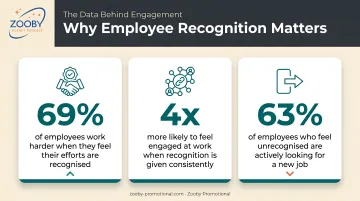
Recognition's impact on retention is well-documented. A longitudinal Gallup-Workhuman study found that well-recognized employees were 45% less likely to have changed organizations over a two-year period. Replacing a manager costs roughly 200% of their annual salary; even frontline roles average around 40%. A structured recognition program represents a fraction of those replacement costs.
Engagement numbers tell the same story:
- 51% of organizations reported higher engagement after implementing a recognition program (SHRM)
- Trust gaps are stark: nearly 90% of employees report high trust in leaders who recognize accomplishments — compared to just 48% where recognition is absent (O.C. Tanner)
- 51% of U.S. employees were actively watching for or seeking new jobs as of mid-2024 (Gallup)
Who Benefits From a Recognition Program?
Recognition programs aren't just for large enterprises. Any organization — from a 15-person startup to a 10,000-person corporation — benefits from structured appreciation. The investment scales accordingly. Budget benchmarks from WorldatWork suggest 0.3% of payroll as a conservative baseline, while O.C. Tanner recommends $200–$350 per employee annually for a comprehensive program.
Types of Employee Recognition to Include in Your Program
Effective programs don't rely on one type of recognition. They layer three distinct levels, each serving a different purpose.
The Recognition Pyramid
| Level | Frequency | Examples |
|---|---|---|
| Formal | Annual or quarterly | Values awards, service milestones, company-wide ceremonies |
| Informal | Weekly or monthly | Handwritten notes, spot bonuses, surprise team lunches |
| Everyday | Daily | Verbal thank-yous, Slack shoutouts, brief public acknowledgment |
All three layers need to exist. A company that only does annual awards — and nothing in between — creates a recognition desert where most employees never feel seen.
Manager Recognition vs. Peer Recognition
These two sources serve different functions:
- Manager-to-employee recognition carries weight for career visibility and status. Employees notice when their boss acknowledges them publicly.
- Peer-to-peer recognition captures contributions managers simply can't see. A colleague knows who stayed late to help the team, who mentored a new hire, who defused a tense client call.
Build both into the program deliberately. Deloitte research found that 85% of professionals want to hear a simple thank-you in daily interactions — a number that speaks directly to the peer and manager relationship, not just annual ceremonies.
Qualities All Good Recognition Shares
No matter the format, recognition should be:
- Timely: delivered close to the moment, not weeks later
- Specific: tied to a behavior or outcome, not just "great job"
- Visible to others when appropriate — public acknowledgment amplifies the impact
- Reaching all roles and departments, not just high-visibility teams
- Connected to company values, so recognition reinforces what actually matters
Generic or delayed praise loses its motivational impact fast. A sincere, specific comment the day after a win beats a vague compliment at the next all-hands. Getting the format right matters — but so does choosing what to recognize with.
How to Build an Employee Recognition Program Step by Step
Step 1 — Define Your Purpose and Success Metrics
Recognition programs without goals drift into inconsistency. Before designing anything, answer: What problem are we solving?
Clear objectives might include:
- Reduce voluntary turnover by 10% over 12 months
- Improve employee engagement scores by 15 points
- Increase manager recognition frequency from monthly to weekly
Set KPIs upfront so you can measure whether the program is actually working, not just whether it's running.
Step 2 — Get Employee Input Before Designing
Survey employees on what recognition actually means to them. Preferences vary significantly — 36% of women prefer written appreciation over verbal recognition (Deloitte), while others want public shoutouts. Build a program around real preferences, not assumptions.
Ask about:
- Preferred format (public, private, written, verbal)
- Valued reward types (time off, tangible gifts, experiences, gift cards)
- How often they want to give and receive recognition
Step 3 — Set Your Budget, Criteria, and Eligibility Rules
Cover these planning essentials before launch:
- Budget: Use 0.3%–1% of payroll as a starting range; $200–$350 per employee annually is a recognized benchmark
- Eligibility: Define who qualifies and how often the same person can be recognized
- Selection process: Who nominates? Who approves? Is it manager-driven, peer-nominated, or both?
- Reward mix: Balance monetary and non-monetary options to reach different employee preferences
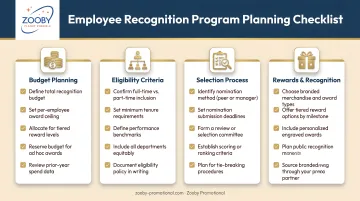
Even modest budgets can power impactful programs with the right mix of tangible items and meaningful gestures.
Step 4 — Choose Your Delivery Channels and Systems
A program without a clear delivery mechanism tends to stall. Budget and criteria only matter if employees can actually see and use the recognition system. Choose a structure:
- Dedicated platform (Bonusly, Workhuman, etc.) for peer-to-peer recognition at scale
- Slack or Teams channel for lightweight daily shoutouts
- Monthly meeting segment dedicated to formal recognition moments
- Company swag store for fulfilling tangible rewards on demand
For teams distributing branded recognition items across multiple locations, an online company store removes the logistics burden entirely. Zooby Promotional, for instance, offers free online swag stores that let HR teams distribute custom-branded merchandise one item at a time, with no bulk purchasing or inventory storage required.
Step 5 — Launch, Measure, and Iterate
Track these metrics after launch:
- Participation rate: What percentage of managers and employees are actively recognizing?
- Recognition frequency: How often is each employee being recognized?
- Engagement survey scores: Are they trending upward quarter over quarter?
- Turnover rate: Are you hitting the retention targets set in Step 1?
Review the data quarterly. Drop what isn't moving the needle and double down on what is.
Employee Recognition Program Ideas That Actually Work
Recognition from Leadership
Individual recognition ideas with strong impact:
- Values-based awards: Monthly or quarterly awards tied to specific company values give recognition real meaning — not just a generic "good job"
- Public shoutouts at all-hands: Naming someone in front of the full company carries weight that a Slack message never will
- Handwritten notes from senior leaders: Rare enough to feel personal, and specific enough to feel genuine
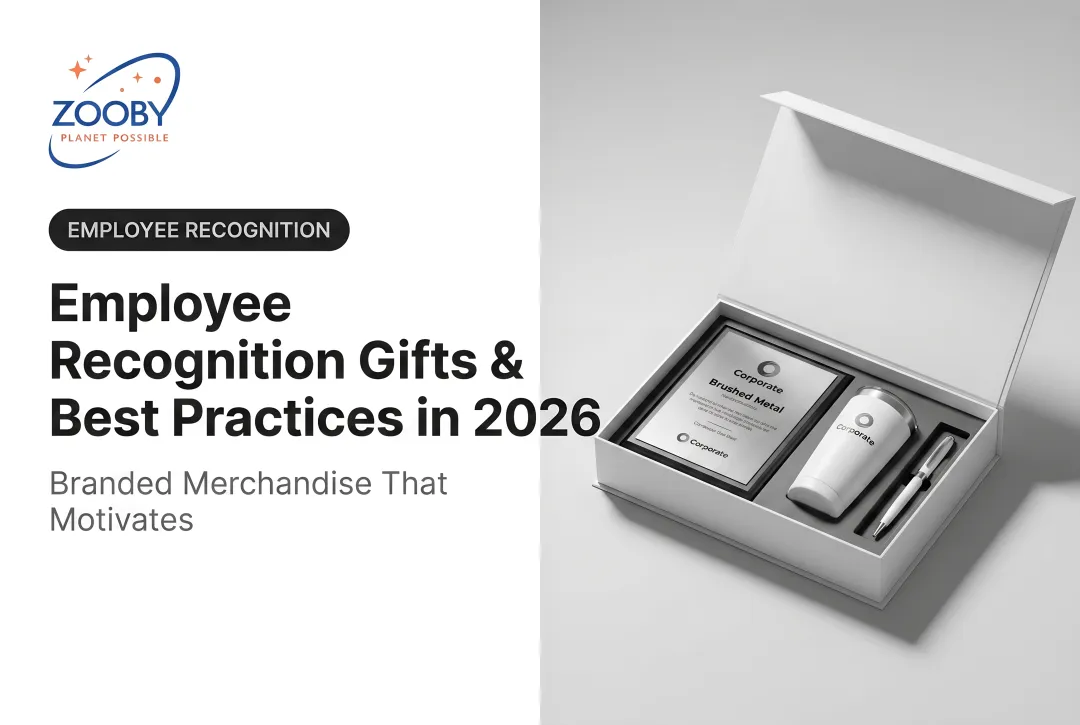
- Branded merchandise and premium swag: A quality tumbler, engraved plaque, or custom award kit becomes a lasting physical reminder of achievement. Zooby Promotional carries options across all of these — drinkware, crystal awards, and executive gift sets employees actually keep and use
Team-level recognition ideas:
- Catered lunches celebrating a project milestone
- Surprise half-days off after a major push
- Sponsored volunteer days as a shared experience
- Wellness kits distributed after a stressful quarter
Recognition from Peers
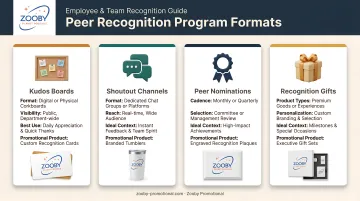
Peer recognition reaches contributions managers miss — and consistently receiving appreciation from colleagues builds team trust. Effective peer recognition formats include:
- Kudos boards (physical or digital) where anyone can post recognition
- Peer-nominated awards surfaced monthly or quarterly
- Shoutout channels in Slack or Teams with clear community norms
- Small peer gifts — a coffee card, a handwritten note, a branded item from the team
Milestone and Achievement Recognition
Celebrating milestones signals that employees are seen as people, not just output.
Work-related milestones to recognize:
- Work anniversaries (1, 5, 10, 15, 20 years)
- Promotions and role changes
- Project completions and product launches
- Certifications or professional development achievements
Personal milestones also matter — birthdays, major life events, and transitions show employees that the organization cares beyond the job description.
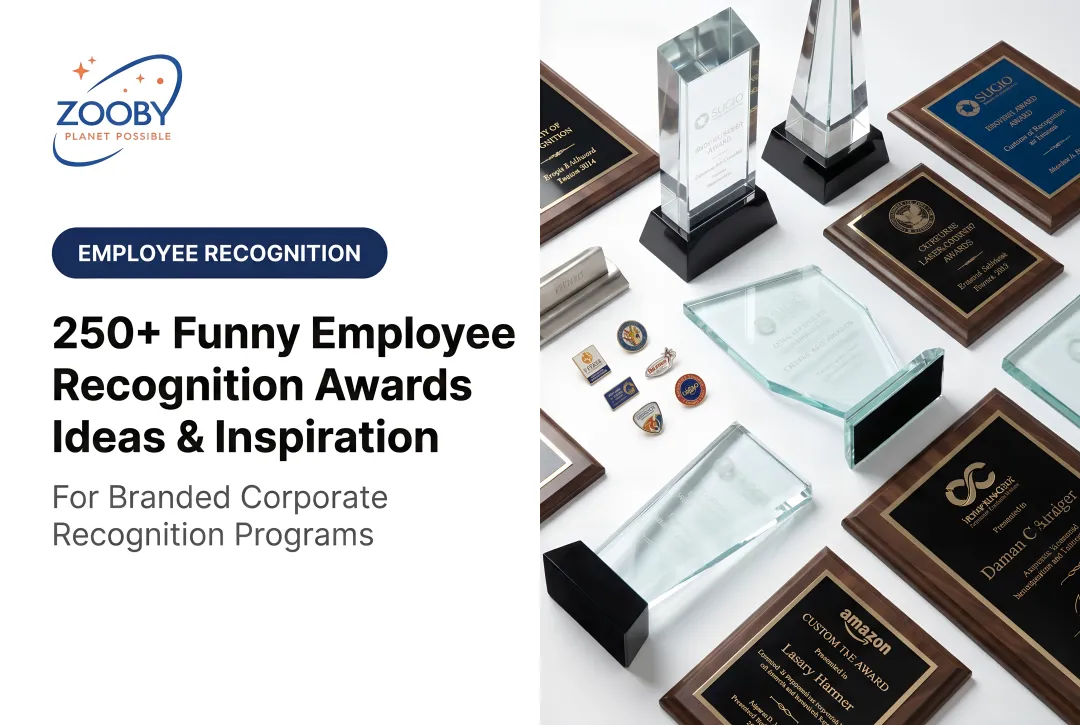
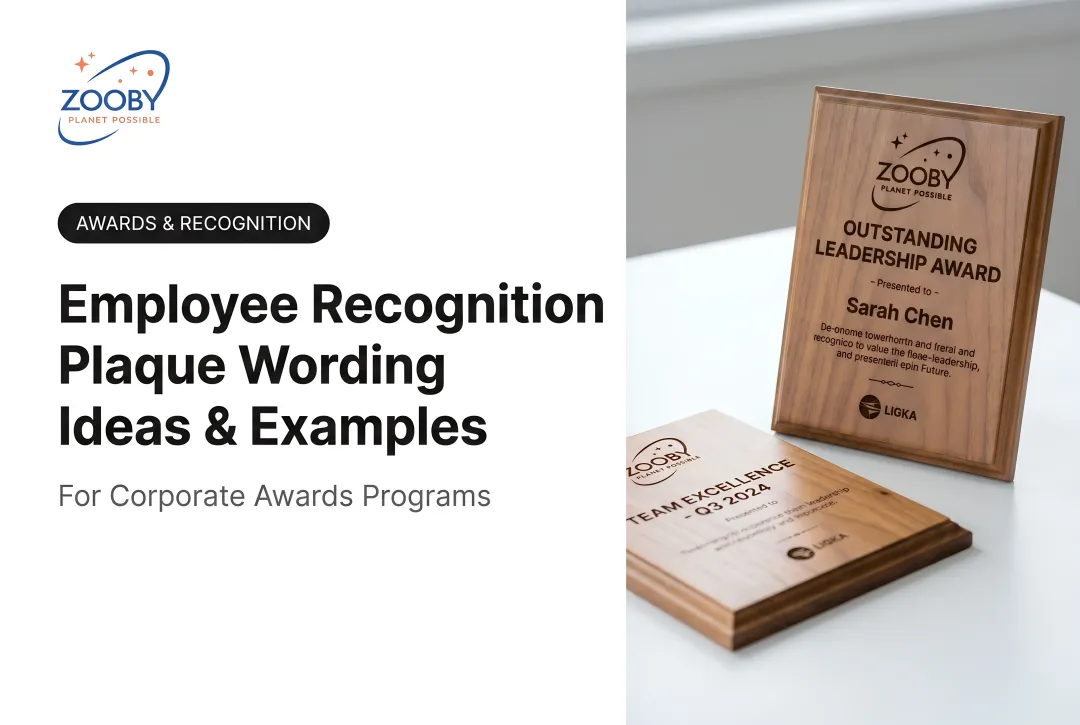
For milestone recognition, consistency matters as much as thoughtfulness. Zooby Promotional offers perpetual award plaques, custom lapel pins, and curated gift sets that scale easily — whether you're honoring one person this quarter or fifty across the year.
Common Employee Recognition Mistakes (and How to Fix Them)
Mistake 1: Recognition That's Too Generic or Delayed
Problem: "Great job last month" is nearly meaningless. Generic praise doesn't reinforce specific behavior, and delayed praise loses the emotional connection to the moment.
Fix: Train managers to recognize in real time with specific, behavior-linked language. Not "good work," but "The way you handled that client escalation on Thursday kept the relationship intact — that mattered."
Mistake 2: Recognition That Only Flows from the Top
Problem: When only managers give recognition, the daily contributions that peers witness go unacknowledged. This leaves gaps that erode morale, especially in collaborative or remote teams.
Fix: Build peer recognition formally into the program — think a dedicated Slack channel, a monthly nomination form, or a team recognition board. Employees should know they're empowered, not just permitted, to recognize each other.
Mistake 3: Programs That Leave Some Employees Invisible
Problem: Programs that favor high-visibility roles, certain departments, or extroverts who thrive on public praise make others feel invisible. This perception of inequity does more damage than no recognition at all.
Fix: Design transparent, equitable criteria. Offer both public and private recognition options. Audit recognition data regularly — if the same five people receive all the awards, the program has a structural problem.
Avoiding these mistakes won't fix everything overnight, but eliminating them removes the biggest barriers between a recognition program that looks good on paper and one employees actually trust.
Frequently Asked Questions
Do employee recognition programs work?
Yes. Research consistently shows recognized employees are more engaged, less likely to quit, and more productive. Effectiveness depends on the program being specific and consistent — not just occasional. A well-run program directly reduces the 45% turnover risk associated with insufficient recognition.
What is an employee recognition and awards program?
It's a structured system for acknowledging employee contributions through formal awards, informal appreciation, and peer recognition. It goes well beyond annual bonuses to include everyday acknowledgment: verbal praise, peer kudos, milestone gifts, and values-based awards throughout the year.
What are some examples of awards and recognition for employees?
Examples include values-based awards, years-of-service milestones, peer-nominated kudos, public shoutouts at company meetings, branded swag and premium gift items, extra time off, experiential rewards, engraved plaques, and custom lapel pins or medals.
What are the four types of reward systems in the workplace?
The four common types are monetary (bonuses, gift cards), non-monetary (public praise, extra PTO), tangible (gifts, merchandise, awards), and social (peer recognition, team shoutouts). Most effective programs combine all four rather than leaning on just one.
What are the top motivators for employees?
Feeling valued and appreciated consistently ranks among the top motivators — alongside meaningful work, growth opportunities, and strong manager relationships. Recognition programs directly address the "feeling valued" driver that surveys like Deloitte's research identify as critical to daily engagement.
What are the 5 C's of employee retention?
The 5 C's are typically Compensation, Culture, Career growth, Connection, and Care. A well-run recognition program directly strengthens Culture, Connection, and Care. That makes it one of the most accessible ways to improve retention without overhauling compensation.