Introduction
The coffee mug with a clip-art logo. The generic "Employee of the Month" plaque that ends up in a car trunk. Most people who've worked in an office know exactly what forgettable recognition looks like — and they remember how it felt.
That feeling is why recognition gifting has changed. What once passed as a thoughtful gesture now reads as an afterthought — especially when employees have more job options, stronger expectations, and less patience for performative appreciation.
The stakes are real: Gallup and Workhuman's longitudinal research found that well-recognized employees are 45% less likely to have left their organization after two years. That's a direct line between your recognition program and your turnover costs.
This guide covers the best employee recognition gift ideas for 2026, what best practices actually look like in practice, how to budget intelligently, and what the IRS rules mean for your program.
Key Takeaways
- Recognized employees are significantly less likely to quit — recognition is a direct retention strategy
- The best 2026 gifts are personalized, practical, and tied to a specific moment — not bulk-ordered and generic
- Manager-delivered recognition outperforms HR-distributed gifts every time
- Remote and hybrid employees need the same quality of recognition as in-office staff — make sure they receive it
- Budget tiers matter: $15–$30 for everyday tokens, $100–$500+ for milestone awards
Why Employee Recognition Gifts Matter in 2026
The Numbers Behind the Gesture
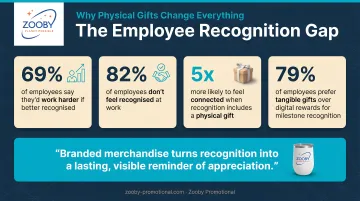
U.S. employee engagement sat at just 31% in 2025, according to Gallup's January 2026 tracking — flat from the prior year and far below what most organizations would consider healthy. Globally, engagement dropped to 20%. At the same time, Gallup estimates 42% of employee turnover is preventable but routinely ignored.
Recognition is one of the most cost-effective levers available. Yet only 22% of employees report receiving the right amount of recognition — a figure that hasn't budged since 2022.
Why Physical Gifts Hit Differently
Verbal praise disappears the moment it's said. A well-chosen physical gift stays on a desk, gets used daily, or sits on a shelf as a reminder that someone noticed. Snappy's 2025 Workforce Study found that 87% of employees believe companies should recognize contributions with tangible tokens of appreciation — not just words.
A gift is something an employee can see, keep, and return to — a quality that matters most to remote and hybrid workers who miss the casual day-to-day feedback of an office setting. With hybrid teams now the norm and multi-generational workforces each carrying different expectations, the case for physical recognition has only gotten stronger.
What Makes a Gift Land vs. Languish
Not all gifts work equally. The type of item, the timing of delivery, and who hands it over all determine whether recognition feels earned or hollow. A $200 gift given awkwardly three months after the achievement will be forgotten. A $30 item delivered by a manager the same week as the win will be remembered for years. The following sections break down both.
Best Employee Recognition Gift Ideas for 2026
The best recognition gifts fall into distinct categories depending on occasion, employee, and budget. A thoughtful choice within any category will outperform an expensive but impersonal one.
Branded Swag & Custom Merchandise
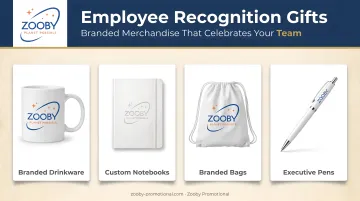
Custom-branded items are one of the most popular recognition categories — and quality is what separates the ones that work from the ones that don't. An insulated tumbler someone reaches for every morning reinforces your brand daily. A flimsy pen that quits after a week does the opposite.
For organizations gifting at scale, Zooby Promotional handles sourcing and fulfillment from branded onboarding kits to milestone gift boxes. Their free Company Store lets HR managers set up a curated online storefront where employees choose their own reward from a pre-approved selection — no inventory to manage, and employees still get personal choice.
Wellness & Experience Kits
Curated wellness gifts — spa sets, fitness accessories, gourmet food boxes, mindfulness tools — signal something specific: that the company cares about the employee as a whole person, not just their output. In distributed teams especially, that distinction lands.
These gifts ship directly to remote employees' home addresses, making them a practical choice for distributed teams. Pair a wellness kit with a handwritten note that references the specific project or contribution — that one detail turns a nice gift into a memorable one.
Milestone & Service Award Gifts
Work anniversaries, promotions, and major project completions call for a higher level of investment. A $15 mug for a 10-year anniversary doesn't just fall flat — it actively communicates that those years of service weren't valued.
Milestone gift ideas by budget tier:
- 1–2 year anniversaries: Premium branded drinkware, quality leather accessories, curated gift sets ($50–$100)
- 5-year milestones: High-end electronics, personalized crystal or wood awards, experience credits ($150–$300)
- 10+ year milestones: Premium luggage, engraved keepsake items, travel credits, custom awards ($300–$500+)
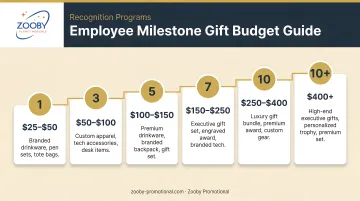
Engraving the employee's name, service date, or a specific message converts a functional item into a keepsake. Zooby Promotional's catalog includes crystal and glass awards, wood awards, metal trophies, and personalized plaques — the kind of items designed to sit on a desk for the next decade.
Everyday Recognition Tokens (Under $30)
Recognition doesn't require a big budget to work. Small, frequent tokens given consistently can build more goodwill than one large annual gift — because frequency signals that someone is paying attention all year, not just at performance review time.
Practical everyday recognition ideas:
- Branded insulated tumbler or ceramic mug ($10–$25)
- Quality notebook paired with a metal pen ($15–$20)
- Branded snack or coffee kit ($20–$30)
- Soft enamel lapel pins or custom wristbands (under $5)
- Gift cards for food delivery or coffee ($15–$25)
The critical piece here is the message that accompanies the item. A $20 recognition token paired with a specific, genuine compliment about a recent piece of work feels personal. The same item handed over with no context feels like an HR checkbox.
Employee Recognition Gift Best Practices
Tie the Gift to a Specific Moment
Gifts given without context feel like administrative exercises. When a recognition gift is tied to an actual event — a difficult client win, a project launch, a quarter where someone carried the team — it feels earned. The employee understands exactly why they're being recognized, and the gift reinforces that specific contribution.
Timing matters enormously here. Recognition delivered within a few days of the achievement lands differently than the same gesture buried in a quarterly review cycle.
Personalize, Even at Scale
At minimum, every recognition gift should include a handwritten or personally signed note. At best, the gift itself should reflect something about the employee: a coffee kit for the person who lives on espresso, a fitness accessory for someone who runs marathons, a premium notebook for the writer on your team.
Gallup's research identifies individualization as one of the five pillars of strategic recognition. Employees whose recognition meets four or more of those pillars are 9x more likely to be engaged than those whose recognition meets none.
For large teams, practical personalization strategies include:
- Employee preference surveys distributed quarterly
- A curated selection of 3–4 gift options per occasion (let employees choose)
- An online company store where employees redeem recognition points toward preferred items
- Working with a promotional products partner that can add individual names or messages at scale
Make the Delivery Count
Having a manager present a recognition gift — in person or via video for remote teams — dramatically increases its emotional impact compared to leaving it on a desk or shipping it with no context. Recognition from a direct manager is the most meaningful form for 40% of employees, according to Snappy's 2025 study.
The act of recognition matters as much as the gift itself. Train managers to deliver recognition verbally before presenting the gift, and to be specific about what the employee did and why it mattered.
Don't Leave Remote Employees Behind
That delivery challenge becomes more acute for distributed teams. Remote and hybrid workers are at higher risk of feeling invisible, and when they leave, it's rarely about pay — it's about feeling unseen. In 2026, any recognition program that hasn't built in explicit processes for remote employees is incomplete.
Practical fixes:
- Ship milestone and holiday gifts directly to home addresses
- Offer digital gift card options alongside physical items
- Ensure remote team members receive equivalent recognition quality — not an afterthought version
Recognize Frequently, Not Just Annually
Gallup recommends managers provide recognition at least every seven days. Only one in three U.S. workers currently agrees they received recognition or praise in the past week. That gap is where engagement erodes — not through dramatic events, but through consistent invisibility.
Frequent small gestures outperform infrequent large ones. A program that builds in weekly or biweekly recognition moments — even informal ones — produces cumulative engagement gains that a single annual award simply can't match.
Budgeting and Tax Basics for Employee Recognition Gifts
How Much to Spend
Industry sources consistently cite 1% of total payroll as the minimum recognition program budget — a benchmark widely associated with SHRM research. O.C. Tanner recommends $200–$350 per employee per year for comprehensive recognition programs, with performance recognition specifically budgeted at $100–$150 per employee annually.
Practical budget tiers by occasion:
| Occasion | Suggested Budget |
|---|---|
| Everyday recognition tokens | $15–$30 per gift |
| Holiday or team appreciation | $30–$75 per employee |
| 1–3 year service anniversaries | $50–$150 |
| 5-year milestones | $150–$300 |
| 10+ year milestones | $300–$500+ |
| Promotions / major achievements | $100–$300 |
The most common budgeting mistake is spending the same amount on every occasion regardless of significance. A tiered policy — established in advance — ensures fairness across teams and prevents the awkward situation where a 10-year veteran gets the same gift as someone completing their first month.
Once your budget tiers are set, the next question is how the IRS treats what you're giving. Tax treatment depends on the type of gift:
IRS Rules in Plain Language
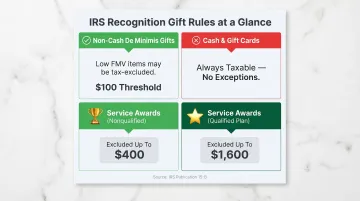
- Non-cash gifts with low fair market value may qualify as de minimis fringe benefits — excluded from taxable income. The IRS hasn't published a fixed dollar threshold, but has indicated that items exceeding $100 in value generally don't qualify.
- Cash and gift cards are always taxable to the employee, regardless of amount. There are no exceptions here.
- Length-of-service awards (tangible personal property only) can be excluded from employee income up to $400 for nonqualified plans or $1,600 for qualified written plans, per IRS Publication 15-B.
- Qualifying service award conditions: The award must be presented as part of a meaningful ceremony and cannot be given before five years of service. Cash, gift cards, vacations, meals, and tickets are explicitly excluded.
Consult a tax professional before finalizing your program structure.
Frequently Asked Questions
What are good employee recognition gifts?
Thoughtfulness beats price every time — a $25 item with a genuine personal note will outlast a $100 generic basket. Good examples include branded insulated tumblers ($20–$30), curated wellness kits ($50–$100), premium crystal or wood service awards ($150–$300+), and gift cards for everyday tokens. What ties them together: each is tied to a specific moment, not just handed out at random.
What are the unwritten rules of work gifting?
Avoid overly personal items (clothing in specific sizes, anything too intimate) and keep gift value appropriate to the relationship and occasion. Never give cash directly — it reads as transactional. Ensure employees at the same level receive comparable recognition to avoid resentment. Always include a personal note, even a brief one, that acknowledges the specific reason for the gift.
How much should companies budget for employee recognition gifts?
SHRM's benchmark is at least 1% of total payroll for recognition programs overall. For individual gifts, typical budgets range from $15–$30 for everyday tokens to $100–$500+ for major milestones. Establish a tiered budget policy in advance so spending stays consistent and fair across managers and departments.
Are employee recognition gifts tax-deductible?
Non-cash gifts of low fair market value may qualify as de minimis fringe benefits and be excluded from employee taxable income — but cash and gift cards are always taxable, regardless of amount. Tangible service awards can be excluded up to $400 (nonqualified) or $1,600 (qualified plan) per IRS Publication 15-B. Consult a tax advisor for your specific program structure.
When is the best time to give employee appreciation gifts?
Work anniversaries, project completions, promotions, Employee Appreciation Day (March 6, 2026), and the holiday season are all natural moments to recognize people. That said, the most impactful gifts arrive closest to the actual achievement — not weeks later at a scheduled event.
How do you personalize recognition gifts for a large team?
Run a quick preference survey before gifting occasions, then offer 3–4 curated options rather than one fixed item. A branded Company Store — like the free solution Zooby Promotional offers — lets employees pick their preferred reward from a pre-approved catalog, with no inventory management required on the HR side.
Conclusion
Recognition gifts in 2026 aren't a nice-to-have perk sitting at the edge of an HR budget. They're a measurable driver of engagement, loyalty, and retention. What separates a gift that resonates from one that gets forgotten? Personalization, timing, and genuine intent — in that order.
For HR managers and business leaders, the shift worth making is simple: move away from one-size-fits-all gifting toward a tiered, occasion-driven strategy that reflects real appreciation for the individuals in it.
For organizations looking to simplify the sourcing, customizing, and fulfilling of recognition gifts, Zooby Promotional has been doing exactly that since 2006 — from branded onboarding kits and milestone award boxes to fully managed Company Stores where employees choose their own rewards. They serve clients across 40+ states. Email sales@zooby-promotional.com to talk through what a recognition program built around your team could look like.