Introduction
Running out of giveaways two hours into a three-day trade show stings. So does hauling 400 untouched tote bags back to the office. Both scenarios waste money — one in lost brand impressions, the other in excess inventory that may never get used.
Neither outcome is inevitable. A straightforward formula exists for calculating how many promotional items to order — one that adjusts for variables like event size, booth location, and your marketing goals.
This guide covers:
- A simple quantity formula with worked examples
- The key factors that shift your numbers up or down
- Which items belong at each tier — and in what quantities
- Distribution strategies that make every item count
TLDR: Key Takeaways
- Small events (under 500 attendees): order for ~75% of expected attendance; large events (1,000+): target ~25%
- Always add a 10–15% buffer on top of your estimate for VIP meetings and unexpected foot traffic
- Use a tiered approach: budget items for casual visitors, mid-range for prospects, premium for qualified leads
- Ordering in bulk across a full event season consistently lowers your per-unit cost
- Zooby Promotional's free Company Store eliminates over-ordering for recurring merchandise needs
How to Calculate How Many Promotional Items to Order
The Core Formula
Start with total expected attendance — available from event organizers or prior registration data. Then apply the appropriate percentage based on event size, and add a buffer on top.
The baseline ratios (per Crestline's trade show planning guidance):
- Small events (under 500 attendees): ~75% of expected attendance
- Large events (1,000+ attendees): ~25% of expected attendance
Then add 10–15% buffer to that subtotal.
Worked Examples
Small event — 400 attendees:
- Base quantity: 400 × 75% = 300 items
- Buffer: 300 × 15% = 45 items
- Total to order: ~345 items
Large event — 2,000 attendees:
- Base quantity: 2,000 × 25% = 500 items
- Buffer: 500 × 15% = 75 items
- Total to order: ~575 items
Tiered Breakdown Within Your Estimate
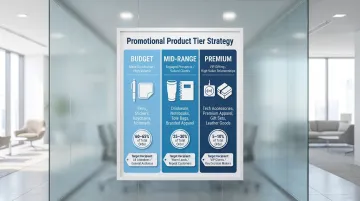
Once you have your total, don't order everything at the same price point. Split your quantity across three tiers to match item value to visitor intent:
| Tier | Examples | % of Total | Who Gets It |
|---|---|---|---|
| Budget | Pens, stickers, lip balms | 60–65% | All booth visitors |
| Mid-range | Drinkware, notebooks | 25–30% | Engaged prospects |
| Premium | Tech accessories, branded apparel | 5–10% | Qualified leads, VIPs |
Two Additional Variables to Factor In
The formula gives you a starting point — but two factors can shift your number significantly before you finalize the order.
- Event duration: A three-day conference needs 3× what a single-day luncheon requires. Don't bring everything on day one — keep a portion in reserve and replenish each morning based on prior-day pace.
- Booth staff supplies: Branded shirts, pens, notepads, and lanyards for your team are easy to forget. Count these separately and add them on top of your attendee-facing quantity.
Key Factors That Shape Your Order Quantity
Your Primary Event Goal
The reason you're exhibiting changes what you need — not just how much, but which tier should dominate.
- Lead generation: Fewer items overall, weighted toward mid-range and premium tiers, distributed through gated interactions (badge scan, demo, brief conversation)
- Brand awareness: Higher volume of budget-tier items for maximum reach across the floor
- Product launch or relationship building: Balanced mix, with branded packaging that reinforces the product narrative
According to Cvent's trade show research, 72% of exhibitors attend shows specifically for lead generation — which means most teams benefit from quality over quantity.
Booth Location
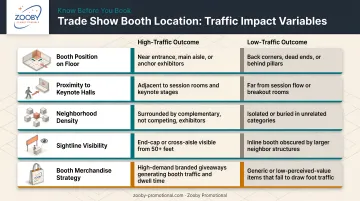
Where you're placed on the floor matters more than most exhibitors realize. Booths within 100 feet of key entrances generate 40% more first impressions than perimeter placements. Corner booths and locations near food courts or session halls see similar traffic spikes.
If you land a high-traffic spot, push your estimate closer to the 50–75% range rather than the low end. A perimeter booth at a massive show might only need the 25% baseline.
One more variable worth tracking: open-table displays deplete inventory 2–3× faster than staff-assisted distribution, so factor in how your team plans to hand things out.
Audience Specificity
- Niche industry conference (attendees closely match your buyer persona): weight toward mid-range and premium tiers; these people are worth investing in
- Large consumer expo (broad, general demographic): volume of budget items matters more than premium depth
Past Event Data
If you've exhibited before, your own numbers beat any formula. Track these metrics at your next event:
- Items distributed per hour (by tier)
- Badge scans or conversations per hour
- What was left over at close — and what ran out first
After two or three events, you'll have a custom ratio that beats any industry rule of thumb.
Choosing the Right Promotional Items (and in What Quantities)
Budget-Tier Items: Order in Volume
These are your high-quantity, wide-distribution items — handed to anyone who stops by. Best options:
- Pens and writing instruments — universally kept, used daily
- Lip balm — practical, compact, low per-unit cost
- Tote bags — the ASI 2026 Global Ad Impressions Study found tote bags generate approximately 5,000 lifetime brand impressions at just $0.001 per impression
- Can coolers, stickers, keychains — easy to ship, easy to carry
Zooby Promotional carries all of these categories, with budget options like neoprene can coolers starting under $1 per unit and non-woven tote bags in the $1.79–$2.35 range — both with minimum orders starting at 150–250 pieces.
Mid-Range and Premium Items: Smaller Quantities, Bigger Impact
Reserve these for prospects who've shown real buying intent:
- Drinkware (insulated tumblers, branded bottles) — high perceived value, kept long-term
- Tech accessories (wireless chargers, power banks) — strong retention rates among professional attendees
- Quality notebooks and portfolios — especially effective for financial services and consulting clients
- Branded apparel — works well as a VIP gift or giveaway incentive
Zooby carries premium drinkware options including YETI® and Stanley tumblers, along with tech accessories and apparel from recognizable brands — items with enough utility and quality that recipients actually keep and use them.
Match Item to Audience
Once you've settled on a budget tier, the next step is matching item type to who's actually in the room:
- Tech conferences: Skip USB drives — attendees already have them. Wireless chargers or cable organizers are more useful.
- Fitness or wellness events: Branded water bottles, gym bags, or protein shaker cups make immediate sense.
- Financial services or professional services: Quality notebooks, portfolios, or pen sets read as thoughtful rather than generic.
Zooby's catalog covers in-stock options across all of these categories, and the team can source or manufacture custom products when a specific industry or brief calls for something outside the standard range.
Smart Distribution Strategies to Make Every Item Count
Don't Put Everything Out at Once
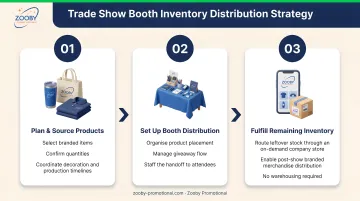
Morning hours at trade shows typically see the highest foot traffic — which means an open table display can drain your entire budget-tier supply before lunch. Instead:
- Start with 50–60% of your budget items visible and accessible
- Check inventory at midday and restock from your reserve
- Adjust pace on day two based on what you learned from day one
Gate Your Premium Items
Premium merchandise should be visible but not freely accessible. Display it prominently — on a back shelf, inside a cabinet, or in a branded gift bag on a stand. But require a qualifying action to receive it:
- Badge scan or business card drop
- Attending a 5-minute product demo
- Entering a raffle that captures contact information
This protects your highest-value inventory for your highest-value interactions. It also opens a natural conversation: "I'd love to get you one of these — can I walk you through what we do?" That question alone can turn a casual passerby into a qualified lead. For contacts you've already identified before the event, though, you'll want a separate plan entirely.
Prepare a VIP Reserve
Set aside a small, separate stash of premium gift bags before the event starts — designated for pre-arranged appointments or key prospects identified from the attendee list in advance. Keep this completely separate from general supply. No matter how busy the floor gets, those contacts receive a curated bag — not whatever's left at the end of the day.
Planning for Leftovers, Stockouts, and Future Events
If You Run Out
The best insurance against mid-show stockouts is ordering in bulk at the start of a multi-event season and drawing from backstock as needed. Per-unit pricing drops significantly at higher quantities — Zooby's pricing structure shows consistent volume breaks, with some items dropping 25–30% per unit from minimum-order pricing to 5,000-unit pricing.
If you do run short mid-event, meter remaining items more carefully rather than scrambling. Reserve what's left for qualified conversations only, and note the pace data for next time.
One planning note: the promotional products industry operates with a standard over/under production variance of up to 10% — meaning your order of 500 items might arrive with 450 or 550. Build that variance into your calculation, and specify shipping instructions clearly if exact quantities matter.
If You Over-Order
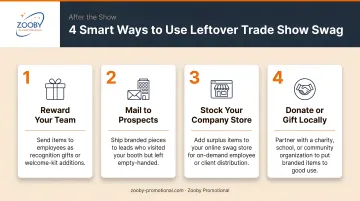
Leftover items aren't wasted if you have a plan:
- Carry forward to your next event
- Run a social media giveaway to extend reach and engagement
- Include in post-event thank-you mailers to prospects you met
- Donate to local schools, charities, or nonprofits — Zooby has helped raise funds for dozens of charitable organizations and schools over its 20 years in business
For organizations with ongoing branded merchandise needs, Zooby's free Company Store solves the over-ordering problem entirely. Items are ordered and fulfilled one at a time through a branded online portal: no inventory to store, no bulk purchasing required, no surplus accumulating between events. Teams that need consistent access to branded merchandise year-round get a turnkey solution without the logistics overhead.
Frequently Asked Questions
How many giveaways should I order for a trade show?
Use the 75%/25% rule: plan for 75% of expected attendees at small shows (under 500), and 25% at large shows (1,000+). For a 400-person event, that's ~300 items; for a 2,000-person event, ~500 items. Add a 10–15% buffer on top of either figure.
What are the most popular promotional items?
Drinkware, pens, tote bags, apparel, and tech accessories lead in units sold across most event types. "Popular" is still audience-dependent, though — a tote bag that resonates at a consumer expo may fall flat at a senior executive summit.
What counts as a promotional item?
Any branded, tangible product distributed to increase awareness, generate leads, or leave a lasting impression. The range runs from low-cost pens and stickers to premium tech gifts and branded apparel.
How far in advance should I order promotional items for an event?
Plan for at least 3–4 weeks for standard catalog orders, and 6+ weeks for large quantities or fully custom items. Ordering early also unlocks better per-unit pricing and eliminates the cost of rush production or expedited shipping.
What should I do with leftover promotional items after an event?
Three solid options: carry them forward to your next event, run a social media contest using them as prizes, or donate them to local schools, charities, or nonprofits.
Should I order the same promotional items for every business event?
Budget-tier staples like pens or tote bags can work across multiple events. But item selection should be revisited for each show based on audience profile, event goals, and geographic context — a water bottle is perfect at an outdoor fitness expo and underwhelming at a law firm conference.