Introduction
Most corporate swag stores don't fail because swag doesn't work. They fail because someone built a store the same way they'd order business cards — pick something, slap a logo on it, and hope people notice.
The result is predictable: a store launches with fanfare, gets a spike of orders in week one, and goes dark by month three. The promotional products industry hit a record $26.6 billion in U.S. sales in 2024. Demand for branded merchandise isn't the problem. Execution is.
This guide walks through 8 concrete steps for building a company swag store that actually gets used — starting with strategy, working through product selection and fulfillment, and ending with what it takes to keep a store active well past launch.
Key Takeaways
- A swag store without a defined purpose becomes a catalog nobody browses.
- Company-funded stores outperform self-pay models — employees love receiving swag, not buying it.
- Product quality matters more than catalog size; a few great items beat a bloated, mediocre catalog.
- Your inventory model (stocked vs. on-demand) shapes cost, speed, and risk — choose based on your actual order volume.
- Quarterly catalog refreshes and a proactive communication calendar keep the store active past the launch window.
Before You Build: Clarifying Purpose and Audience
Skipping the strategy phase is how companies end up with a store full of products nobody wanted, funded with a budget nobody thought through, promoted to an audience nobody defined. Fix this first.
Step 1: Define the Purpose of Your Swag Store
Before you touch product selection or platform setup, answer these questions directly:
- Why does this store need to exist? Is it replacing an ad-hoc ordering process, launching a formal recognition program, supporting field sales teams, or something else?
- What specific goals will it serve? Brand awareness, employee recognition, event support, customer gifting, onboarding kits — each requires a different product mix and access model.
- How will success be measured? Order volume, participation rate, product utilization, or employee satisfaction scores?
Your answers here drive every downstream decision. A store built for employee recognition stocks different items than one built for customer gifting — and the fulfillment logic shifts just as much.
Get specific. Vague goals produce vague stores. "We want every new hire to receive a curated onboarding kit within their first week, and every employee to order at least two items per year" is a purpose you can actually build around.
Step 2: Know Who Will Use It and How
Once you know why the store exists, the audience question shapes everything else — what goes in it, who can access it, and how orders get funded.
Ask yourself:
- Is this store for employees only, customers, event attendees, channel partners, or some combination?
- Will access be open or password-protected by user group?
- Will use of the store be mandatory for all branded merchandise orders (which concentrates volume and protects brand consistency), or optional alongside other vendors?
Then tackle the funding question — because this is where most stores break down. Will purchases be:
- Employee-funded (low participation, even with great products)
- Company-subsidized (fixed annual credits or milestone-based budgets)
- Points-based (earned through performance, tenure, or safety milestones)
Each model produces very different participation rates. Get this decision made before launch, not after you've noticed that nobody's ordering.
Making the Store Worth Using: Funding and Communication
A well-designed store with great products still underperforms without the right funding model behind it — and disappears without a consistent communication plan driving people back.
Step 3: Fund the Store Strategically
Employees love receiving branded swag. They're far less enthusiastic about purchasing it with their own money. According to PPAI's 2023 Consumer Study, 78% of people enjoy receiving branded items and nearly 73% want to receive them more often — but enjoyment of receiving something and willingness to pay for it are very different things.
Yet nearly 66% of organizations have no dedicated budget for employee recognition, according to SHRM — which explains why so many stores launch and then flatline.
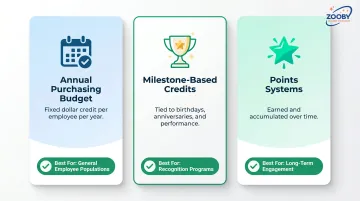
The three most effective funding models:
| Model | How It Works | Best For |
|---|---|---|
| Annual purchasing budget | Fixed dollar credit per employee per year | General employee populations |
| Milestone-based credits | Credits tied to birthdays, anniversaries, performance | Recognition-focused programs |
| Points systems | Earned and accumulated over time | Long-term engagement programs |
Platform costs can quietly consume a store's budget before a single item ships. Zooby Promotional offers its company store solution free to current and prospective clients, which means the budget goes toward merchandise and employee credits rather than infrastructure.
Step 4: Build a Communication Plan Before Launch Day
The "out of sight, out of mind" problem hits swag stores fast. Without intentional, scheduled communication, even a well-funded store loses traction within the first 60–90 days.
An effective communication strategy includes:
- Monthly touchpoints — e-blasts or newsletter features highlighting new items, limited-time offers, or free shipping windows
- Embedded reminders — store links in onboarding materials, performance review packets, and Slack or Teams channels
- All-hands visibility — a brief mention in company meetings when new products drop or a seasonal promotion runs
- A 12-month calendar — planned in advance, not reactive. Map out seasonal promotions, product refreshes, and milestone moments before the store goes live
The goal is to make the store feel like a living benefit, not a forgotten URL in an old email.
Stocking It Right: Products, Feedback, and Freshness
Product selection is where swag stores win or lose employee loyalty. An outdated or generic catalog drives disengagement just as quickly as no communication.
Step 5: Select Products That Match Your Audience and Budget
Fewer high-quality, on-brand items consistently outperform sprawling catalogs of cheap options. Employees are more likely to wear and use items that feel intentional and premium — and those items do more brand-building work in the real world.
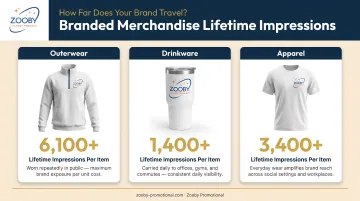
ASI's 2023 Ad Impressions Study shows why category selection matters:
| Category | Lifetime Impressions Per Item |
|---|---|
| Outerwear | ~7,850 |
| T-shirts | ~5,053 |
| Drinkware | ~3,162 |
Prioritize high-wear, high-visibility items. A quality fleece jacket generates nearly 8,000 impressions over its lifetime — far more value than a cheap tote bag that gets used once.
Match products to audience and use case:
- Everyday employee use calls for branded apparel, insulated drinkware, and notebooks
- Remote or traveling teams benefit most from tech accessories, laptop bags, and travel gear
- Onboarding kits work best as curated bundles that make a strong first impression
- Customer gifts should feature premium items with subtle, clean branding
On that last point: subtle logo placement consistently gets more real-world usage. Heavily branded items often stay in the drawer. The goal is merchandise people are genuinely proud to own.
Step 6: Survey Employees and Listen to Their Preferences
Sending a simple survey before launch — or when refreshing an existing store — is one of the highest-leverage things you can do. When employees feel like they shaped the catalog, they become advocates who promote the store organically.
A good swag survey asks about preferred product categories, acceptable price points, sizing preferences, how often employees want new items, and what's missing from the current catalog. Five questions, sent once, can shape a catalog that actually gets used.
Employee word-of-mouth is a cost-free marketing channel for the store itself. When people talk about what they received or what they're hoping gets added, that organic conversation drives participation across departments in ways no email blast can match.
Step 7: Keep the Catalog Fresh with Regular Updates
A static catalog is one of the fastest ways to kill swag store momentum. Employees who visit and see the same items month after month stop visiting — and eventually forget the store exists. A simple refresh schedule keeps things moving:
- Quarterly: retire slow movers and introduce new styles or categories
- Seasonally: drop limited-edition collections tied to the time of year (outerwear in fall, summer gear in Q2)
- Event-driven: launch items tied to company milestones, product releases, or annual events
Treat catalog updates like product drops, not housekeeping. A brief announcement when new items arrive gives people a reason to check back in — and keeps the store feeling like something worth paying attention to.
Setting the Rules: Pricing, Policies, and Inventory
Step 8: Decide on Pricing Logic and Your Inventory Model
Pricing transparency matters more than you'd expect. Baymard Institute data shows the average online cart abandonment rate is ~70%, with unexpected extra costs — shipping, fees, taxes — cited as the top reason at roughly 39%. Your internal store isn't immune to this. Make pricing, shipping thresholds, and any decoration or minimum-quantity requirements visible before checkout.
Pricing models to consider:
- At cost (maximizes employee access)
- Company-subsidized (items offered below cost, company covers the gap)
- Retail markup (store generates revenue that funds future catalog updates)
- Points redemption (items have a points value, not a dollar price)
Pricing logic and fulfillment structure go hand in hand — your inventory model determines how quickly orders ship and how much overhead you carry. There are three core approaches:
| Model | How It Works | Best For |
|---|---|---|
| Fully stocked | Pre-purchased and warehoused; fast delivery | High-volume evergreen items |
| On-demand | Produced as orders come in; no storage risk | Campaign products, experimental items |
| Hybrid | Mix of stocked staples and on-demand specialty | Most mid-to-large stores |
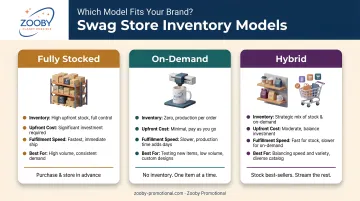
Zooby Promotional's company store setup supports all three models, with access to thousands of in-stock products and fully custom manufacturing — so the fulfillment strategy can align with actual order volume rather than a blanket approach.
Common Mistakes to Avoid When Building a Corporate Swag Store
Even well-intentioned stores run into the same problems. Avoid these:
Don't bulk-order before launch. Purchasing inventory based on assumptions rather than real demand data leads to slow-moving stock that drains budget and storage space. Start smaller than you think you need.
Name an internal owner before go-live. Stores without a designated champion drift into neglect within the first quarter. Assign someone responsible for catalog updates, communications, and usage reporting before launch.
Strike the right branding balance. Too little logo and you miss the awareness opportunity. Too much and the item never leaves the office. Aim for merchandise people are proud to wear — brand-visible without feeling like a uniform.
Frequently Asked Questions
What is considered company swag?
Company swag is any branded merchandise a business provides to employees, clients, or prospects. It typically includes apparel, drinkware, tech accessories, bags, and office items imprinted with the company's logo or brand identity.
What swag do employees actually want?
Employees consistently prefer high-quality, useful items they'd choose for themselves: premium hoodies, insulated tumblers, tech accessories, and lifestyle products. Quality and personal relevance consistently outweigh novelty or quantity — employees keep and use items that feel like real gifts, not afterthoughts.
Should the company fund the swag store or have employees pay?
Company-funded stores drive significantly higher participation. Employees enjoy receiving swag but rarely purchase it on their own. Annual credits, milestone-based budgets, or points programs are the most effective ways to drive consistent store engagement.
Do you need to hold inventory to run a corporate swag store?
No. Many successful stores use on-demand fulfillment, which eliminates storage costs and upfront inventory risk. The right model depends on order volume, product types, and how quickly recipients need their items.
How often should you update your corporate swag store catalog?
At minimum, quarterly. Retiring slow movers, adding seasonal items, and rotating in new styles gives employees a reason to return — and shows the store is well-maintained and worth revisiting.