Here's the problem: most companies severely underestimate what a swag store actually costs. Setup fees get all the attention, while fulfillment costs, decoration setup charges, and ongoing management time quietly double the real number.
This article breaks down every cost tier, every line item, and every common mistake — so you can build a budget that reflects what your store will actually cost to run.
Key Takeaways
- Setup costs range from $0 (managed partner stores) to $20,000+ (custom enterprise builds), with mid-range platforms typically falling between $500–$3,000
- The biggest cost drivers: fulfillment model, decoration method, catalog size, and whether you manage operations internally or through a partner
- On-demand stores carry zero inventory risk but higher per-unit costs; bulk inventory models cut per-unit costs but introduce warehousing fees and overstock exposure
- Managed stores can cut your all-in spend, provided per-item and fulfillment costs are scoped clearly before launch
How Much Does It Cost to Set Up a Company Swag Store?
There's no single price tag. Total cost depends on the model you choose, the partner you work with, and your operational scope. The most common budgeting mistake is treating setup cost as total cost of ownership: companies often look only at the platform fee and overlook decoration setup charges, per-order fulfillment costs, and ongoing admin overhead.
Here's a quick-reference breakdown before we dig into each tier:
| Store Type | Typical Setup Cost | Monthly Ongoing | Best For |
|---|---|---|---|
| Entry-Level / On-Demand | $0–$500 | Minimal (per-order fees) | Small-to-mid companies, schools, nonprofits |
| Mid-Range / Platform-Managed | $500–$3,000 | $50–$300/month | 100–1,000 employee companies |
| Enterprise / Custom-Built | $5,000–$20,000+ | $1,000–$5,000+/month | 1,000+ employees, multi-region operations |
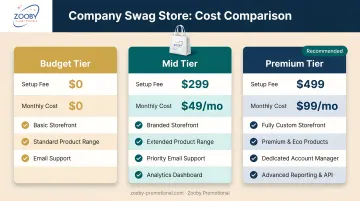
Entry-Level / On-Demand Managed Store ($0–$500)
What's included:
- $0 platform setup fee (partner-hosted)
- On-demand fulfillment — no inventory to purchase or store
- Access to a pre-built product catalog with decoration included in per-item pricing
- Artwork setup fees may apply per design (typically $25–$75 per logo setup)
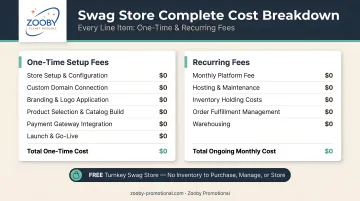
Some full-service promotional partners, including Zooby Promotional, offer company store setup at no cost to clients, with ordering and fulfillment handled end-to-end as a fully managed service.
Best for: Small-to-mid-size companies, nonprofits, and schools with moderate order volume and no space for inventory storage.
Mid-Range / Platform-Managed Store ($500–$3,000)
What's included:
- Dedicated branded storefront (Shopify-based or swag-specific SaaS)
- Basic store interface customization
- HR or SSO integration
- Monthly platform fee: typically $50–$300/month recurring (SwagUp's plans, for example, range from $0 to $800/month depending on tier)
Best for: Companies with 100–1,000 employees that need credits/redemption functionality, better reporting, and more control over product curation without building from scratch.
Enterprise / Custom-Built Store ($5,000–$20,000+)
At this tier, you're buying infrastructure, not just software. Setup covers:
- Fully custom storefront design
- Advanced integrations (HRIS, CRM, SSO)
- Warehousing and pick-pack-ship infrastructure
- Dedicated account management and global shipping
Ongoing costs typically add $1,000–$5,000+/month for warehousing, tech maintenance, and administration — so budget for the full lifecycle, not just launch.
This tier suits organizations with 1,000+ employees, multi-region operations, high-volume recurring orders, and strict brand governance requirements.
Key Factors That Drive Your Swag Store Costs
Beyond the setup tier, four operational variables have the largest impact on what you'll spend month to month.
Fulfillment Model: On-Demand vs. Bulk Inventory
This is the single biggest lever in your cost structure.
| On-Demand | Bulk Inventory | |
|---|---|---|
| Upfront spend | None | High (product purchase + setup) |
| Per-unit cost | Higher | Lower at volume |
| Storage fees | None | $0.43–$0.53/cubic ft/month (3PL) |
| Overstock risk | None | Real — especially when branding changes |
| Lead times | Longer per order | Faster for stocked items |
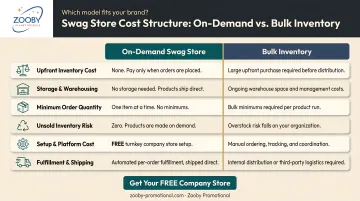
A custom tee that costs $19–$25 per unit on-demand may drop to $12–$15 at 250+ units in bulk — but that saving evaporates quickly once you add warehousing fees, pick-and-pack charges ($2.50–$5.00 per order), and the risk of unsold inventory.
Product Type and Decoration Method
Once you've settled on a fulfillment model, decoration method becomes the next major cost driver — affecting both setup fees and per-unit pricing:
- Screen printing: $15–$25 per screen per color
- Embroidery digitizing: $10–$60 per logo (stitch count dependent)
- Full-color sublimation: No per-color screen fees, but substrate-limited
Premium product categories (tech accessories, outerwear, premium drinkware) push per-item costs well above than tees or tote bags — and each category requires its own decoration setup.
Catalog Size and SKU Count
Catalog size compounds costs faster than most teams expect:
- Each new SKU requires artwork setup, sample approval, and often separate supplier sourcing
- A store with 5–8 core SKUs costs considerably less to maintain than one with 40+
- Decoration setup fees multiply across product categories
- Every refresh cycle resets some of those charges
Shipping Geography
- Domestic standard shipping: USPS Ground Advantage starts at $7.90 per package; online rates run lower
- Multi-state distributed teams: Carrier rates vary by weight, dimensions, and distance
- International: U.S. import Merchandise Processing Fees alone run $33.58–$651.50 per entry, plus applicable duties by country and product category
Companies with distributed or global teams must include per-shipment landed cost in every per-order calculation.
Complete Cost Breakdown: Every Line Item to Budget For
| Cost Category | One-Time or Recurring | Typical Range |
|---|---|---|
| Platform / storefront setup | One-time (or free) | $0 managed; $5,000–$15,000 custom; $50–$300/month SaaS |
| Artwork / logo digitizing | One-time per design | $15–$25/color (screen); $10–$60/logo (embroidery) |
| Per-item product + decoration | Recurring (per order/batch) | See ranges below |
| Fulfillment / pick-pack-ship | Recurring (per order) | $2.50–$5.00/order + shipping |
| Warehousing / inventory storage | Recurring monthly (if applicable) | $0.43–$0.53/cubic ft/month; $200–$800+/month |
| Store administration / management | Recurring (ongoing) | ~$34.59/hour (BLS median for purchasing/admin roles) |
Per-unit ranges for common swag items (based on Zooby Promotional catalog data):
- Branded t-shirts: ~$14–$19/unit at 50–100 units
- Tumblers/drinkware: ~$6–$20/unit depending on style and volume
- Structured caps/hats: ~$8–$13/unit at moderate quantities
- Tote bags: ~$2–$4/unit for cotton canvas at 100+ units; non-woven options run lower
Setup fees — typically $50–$65 at Zooby Promotional — are charged separately from per-unit pricing, so treat them as a distinct line item for each product in your catalog.
The admin cost most companies miss: If an internal buyer or marketing coordinator spends 10 hours per month managing a mid-size store, that's ~$346/month in real labor cost at BLS median wages — a number that rarely appears in any vendor quote or platform pitch.
Managed vs. Self-Built Swag Store: What's the Real Cost Difference?
This is the most consequential decision you'll make when setting up a company store.
Self-built / in-house store:
- Platform development or customization: $3,000–$15,000+
- Ongoing tech maintenance and supplier management
- Internal staff to handle orders, inventory, and quality control
- Direct supplier relationships to negotiate
- Higher control, but significantly higher total overhead
Managed / turnkey partner store:
- Setup often at no cost
- Product sourcing, decoration, fulfillment, and logistics handled by the partner
- Internal admin time drops to near zero
- No warehousing fees; no overstock exposure
That gap matters when you're deciding where to spend. Zooby Promotional's company store model follows the managed approach: free store setup, on-demand fulfillment, and no requirement to purchase or hold inventory. For businesses that don't want to tie up budget in warehousing or staff hours, that structure makes a measurable difference.
12-month cost comparison: A self-managed store stocking inventory for 200 employees can easily reach $8,000–$15,000 in year one once you factor in platform costs, warehousing, staff time, and overstock write-offs. A managed on-demand store for the same group carries higher per-unit costs but zero warehousing and minimal admin — and typically costs less overall when order volumes are moderate or hard to predict.
Budgeting Mistakes That Lead to Overspending
1. Focusing only on sticker price per item
Secondary costs — artwork setup, per-order fulfillment, platform subscription — routinely add 30–60% to the apparent per-item price. A "$10 t-shirt" can land at $18–$22 all-in once decoration setup, pick-pack handling, and shipping are included. Vendor quotes frequently exclude setup fees, color charges, and shipping — making initial comparisons misleading and final invoices a surprise.
2. Over-ordering bulk inventory to chase per-unit savings
Bulk pricing is real, but it only makes sense when order volume is predictable and designs are stable. Logos change, teams rebrand, and new hires often need different items than existing staff. On-demand models, despite higher per-unit costs, often deliver better total ROI for organizations with variable or moderate order volumes — and eliminate the overstock problem entirely.
3. Treating the store as a passive asset
Managing a swag store requires ongoing attention. The work typically includes:
- Refreshing the product catalog as items go out of stock or become dated
- Coordinating with suppliers on lead times and quality issues
- Resolving order errors and customer complaints
- Managing redemption credits or budget allocations
Companies that don't budget for this absorb unexpected labor costs mid-year. If you're managing the store internally, build 8–15 hours per month of staff time into your budget from day one.
4. Choosing on price without vetting fulfillment quality
A lower platform fee or per-unit cost from an unreliable vendor can produce quality complaints, order errors, and brand damage that far exceeds any initial savings. Evaluate partners on decoration quality, fulfillment accuracy, and communication track record — not just the line-item price.
Frequently Asked Questions
How do you create a company swag store?
Define your purpose (onboarding, recognition, brand promotion), select a platform or full-service partner, curate a product catalog, and configure payment or credit options. Managed partners can compress this to a few days rather than several weeks, since they handle setup, sourcing, and fulfillment configuration on your behalf.
How much does a company swag store cost per month to maintain?
Managed or SaaS-based stores run $0–$300/month in platform fees. Self-managed stores with warehousing, admin labor, and ongoing product refresh can reach $800–$2,000+/month once all-in costs are accounted for.
Are there free company swag store options available?
Yes. Some full-service promotional partners offer $0 setup and no ongoing platform fee, covering costs through per-item product pricing. For organizations that want no upfront investment, this works well — as long as per-item and fulfillment costs are clearly scoped before launch.
What is the difference between on-demand and inventory-based swag stores in terms of cost?
On-demand stores carry no upfront inventory spend or warehousing fees, but cost more per unit. Inventory-based stores require bulk purchasing and storage, but reduce per-unit costs at volume. Your best fit depends on how predictable and frequent your orders are.
How much do branded swag items typically cost per unit?
Approximate ranges: basic tees $8–$25 depending on quantity and decoration; tumblers/drinkware $6–$45; tech accessories $12–$60+; premium outerwear $50–$165+. Bulk ordering at 100+ units typically reduces per-unit cost by 20–40% compared to small-batch or on-demand orders.
What ongoing costs should I expect after launching?
Key recurring costs to plan for:
- Platform subscription fees (if applicable)
- Per-order fulfillment and shipping charges
- Artwork update fees when branding changes
- Warehousing fees if carrying inventory
- Internal admin time for catalog and order management