Finding products that are authentically sustainable, branded well, and delivered on time is harder than it looks — but it's worth getting right. According to PwC's 2024 Voice of the Consumer Survey, 80% of consumers are willing to pay more for sustainably produced goods, with an average premium of 9.7%. That's not a niche preference — it's a mainstream expectation.
This guide covers how to evaluate materials, which certifications actually matter, how to match products to programs, and what to demand from your supplier so your eco-friendly swag holds up to scrutiny.
Key Takeaways
- Start with the material and certification — not the logo treatment
- GOTS, GRS, FSC, and bluesign are product-level certifications; B Corp is company-level — don't conflate them
- Vague terms like "eco," "natural," or "green" with no certification are the first sign of greenwashing
- Match product tier to actual use — how the item will be used and how long it needs to last
- Ask suppliers for SKU-level certification documentation, not just catalog labels
Why Eco-Friendly Promotional Products Are No Longer Optional
Sustainability has moved past brand positioning — it's now a purchasing filter. A PwC survey found 80% of consumers are willing to pay more for sustainably produced goods, which means brands treating it as an afterthought are leaving real perceived value on the table.
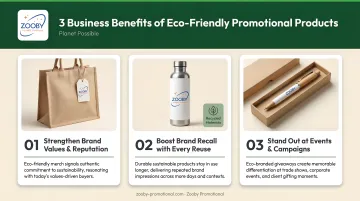
Promotional products are uniquely suited to carry an environmental message forward. Unlike a digital ad that disappears after a scroll, a physical item is handled repeatedly. PPAI's research of 5,674 U.S. and Canadian consumers found 48.7% keep promotional products for more than five years, primarily because the items are useful. Every time someone picks up that tote or reaches for that water bottle, the brand impression renews.
The business case extends well beyond marketing reach. Eco-friendly merchandise supports CSR and ESG commitments that matter to both customers and prospective employees. Consider what that means in practice:
- 46% of consumers feel more favorable toward brands that give them environmentally friendly promotional products (ASI)
- Sustainable sourcing decisions directly strengthen ESG reporting and stakeholder communications
- Branded eco-products reinforce environmental commitments at every touchpoint — not just in campaign materials
Start With the Material, Not the Decoration
Most companies get the sequence wrong. They finalize the design, pick decoration colors, then treat the blank product as an afterthought. The environmental impact of a promotional item is determined primarily by what it's made of and how it was manufactured — not the imprint method.
Material Categories Worth Trusting
| Material | Why It Works | What to Look For |
|---|---|---|
| Organic cotton | Full supply chain audited from field to finished fabric | GOTS certification |
| Recycled polyester/RPET | Post-consumer plastic bottles repurposed into bags, apparel, accessories | GRS certification (50% min. recycled content) |
| Bamboo | Fast-growing, minimal pesticides — suitable for pens, utensils, drinkware | Note: bamboo textiles are often rayon; confirm fiber type |
| Stainless steel | Durable, reusable, reduces repeated single-use demand over time | Look for quality gauge; longevity is the sustainability argument |
| Recycled/FSC-certified paper | Notebooks, seed paper, packaging inserts | FSC chain-of-custody documentation |
Zooby Promotional's catalog includes GOTS and Fair Trade certified organic cotton products (including the TERRA THREAD Executive Work Tote), multiple RPET product lines like the RejuVe recycled heather collection, FSC-certified spiral notebooks, and a range of seed paper items — from bookmarks to herb patch matchbooks.
What to Avoid
Steer clear of any product described only as "eco-friendly," "natural," or "green" with no supporting certification or material specifics. These terms carry no legal definition and no audit trail. When a supplier can't point to documentation, the claim is unverifiable — and unverifiable claims don't hold up to scrutiny.
Lifecycle Thinking
One durable item that gets used for five years beats two cheaper items that end up in a landfill after six months. Evaluate products from raw material sourcing through manufacturing, shipping, use, and end-of-life — whether they're recyclable, compostable, or biodegradable.
Once you've evaluated the product itself, turn to how it gets decorated. Decoration method is a secondary sustainability factor, but it still matters. Water-based and dye-sublimation inks are preferable to PVC-based or solvent inks — ask your supplier specifically which ink systems are used on the products you're quoting.
How to Spot Greenwashing: Certifications That Actually Mean Something
Third-party certifications are the most reliable way to verify a sustainability claim. A supplier who can't point to a named certification backing their claim is leaving you with marketing language — not proof.
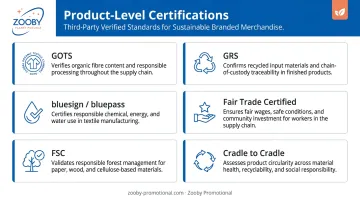
Product-Level Certifications
These apply to the item, material, or process — and are what you need when evaluating a specific SKU:
- GOTS (Global Organic Textile Standard) — organic fibers plus full environmental and social supply chain audit
- GRS (Global Recycled Standard) — minimum 50% recycled content with processing, chemical, and social requirements
- bluesign/bluepass — safer chemistry and responsible resource use in textile production; bluepass labels include QR codes linking to verification
- Fair Trade Certified — ethical labor conditions and fair wages in the supply chain
- FSC (Forest Stewardship Council) — responsible sourcing for paper, wood, and packaging
- Cradle to Cradle Certified — product designed for safe recycling or biodegradation at end of life
Company-Level Certifications
These verify the supplier's environmental and social performance — not any individual product:
- B Corp Certification — company-wide social and environmental accountability
- 1% for the Planet — verified commitment to environmental giving
A B Corp supplier signals organizational values. A GOTS-certified tote bag makes a claim about that specific item. Never use a company-level credential to imply the product itself is certified — those are two different things.
How to Verify a Supplier's Claims
Ask suppliers to share certification documentation for the exact SKU being quoted — not a general company sustainability page. If they can't produce it, treat the claim as unverified. The FTC Green Guides specifically warn against broad, unqualified environmental benefit claims — "eco-friendly" with no substantiation falls into that category.
Common greenwashing red flags:
- Recycled packaging on a non-recycled product
- "Eco" or "green" language with no certification cited
- Cherry-picked claims that ignore the rest of the supply chain
- Company certifications presented as product certifications
Match the Product to the Use Case and Audience
Not every eco-friendly product is right for every program. The material tier and product type should align with how the item will actually be used, who receives it, and how long it needs to last.
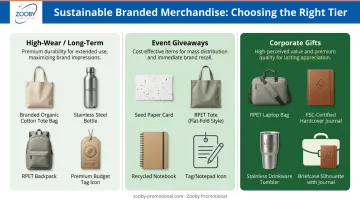
A Practical Framework
High-wear, long-term items (outerwear, bags, bottles):
Invest in premium sustainable materials — organic cotton, stainless steel, RPET backpacks. Longevity justifies the cost and maximizes the environmental benefit. A $45 GOTS-certified executive tote used daily for three years delivers far more value per dollar spent than a $5 bag that falls apart in six months.
Event giveaways and conference swag:
Mid-tier recycled-blend materials hit the right balance of credibility and cost. These items communicate sustainability without requiring premium budgets. Good options include:
- Seed paper notepads and biodegradable pens
- RPET totes and recycled-blend drawstring bags
- Recycled notebooks and kraft paper journals
Corporate gifts:
Prioritize quality and functionality. Executives respond well to sustainable items that are also practical — RPET laptop bags, FSC-certified journals, stainless steel drinkware. The dual message (environmentally responsible + premium quality) resonates more than sustainability alone.
A Note on Color Matching
One practical detail that often catches buyers off guard: recycled and natural materials can have limited color options due to manufacturing constraints. Natural canvas, for example, won't achieve the same saturated colors as a synthetic substrate. Order samples before committing to a large run and confirm colors align with your brand guidelines.
What to Look for in an Eco-Friendly Promotional Products Supplier
The supplier relationship matters as much as the product itself. A knowledgeable partner can eliminate significant vetting time and prevent expensive mistakes on timelines and quality.
Key Supplier Evaluation Criteria
- Transparency about supply chain and sourcing practices
- SKU-level certification documentation available on request, not just catalog labels
- Domestic stock of certified sustainable inventory for rush timelines
- Experience with sustainable decoration methods (water-based inks, laser engraving, dye sublimation)
- Order consolidation capability to reduce freight emissions — one shipment is better than three on both cost and carbon footprint
The Rush-Timeline Myth
Sustainable options no longer automatically mean longer lead times. Suppliers who hold certified sustainable inventory domestically can decorate and ship within standard production windows. The key is building a shortlist of pre-approved eco-friendly SKUs before a deadline hits — not starting from scratch when an event is two weeks away.
Zooby Promotional, for example, holds certified sustainable inventory domestically with standard production running 3–5 working days and rush options available on qualifying SKUs. When catalog options don't fit the brief, their global sourcing capabilities support fully custom eco-friendly manufacturing: bespoke RPET bags, custom organic cotton apparel built to exact spec, produced through overseas manufacturing partners.
For ongoing programs, Zooby's free Online Swag Stores let clients distribute eco-friendly branded merchandise on demand, one item at a time, with no inventory to purchase or store. Companies managing CSR programs across multiple locations or employee groups find this especially useful.
How to Communicate Your Sustainability Choices
Sourcing sustainable products is only half the equation. If recipients don't know why the item is eco-friendly, the brand impact is lost. Recipients who understand the choice are far more likely to connect it to your brand values — and share that story with others.
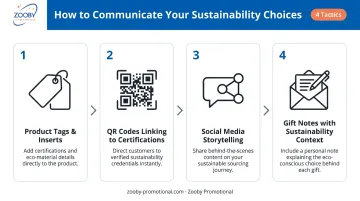
Practical Communication Tactics
- Product tags or packaging inserts — a brief callout noting the certification ("Made with GOTS-certified organic cotton") costs almost nothing and adds real credibility
- QR codes linking to sourcing details or certification documentation — PPAI's 2024 Product Responsibility Summit featured items with QR codes linking directly to material traceability information; bluesign's bluepass system uses the same approach
- Social media storytelling — share the story behind the materials (how many plastic bottles were recycled to make a tote, for example)
- Event or gift notes — a single sentence in a corporate gift note explaining the sustainable choice signals intentionality
Avoid Overstating Environmental Claims
These tactics work best when what you communicate maps exactly to what your certifications actually support. Overstating environmental benefits is a form of greenwashing, and if scrutinized, can damage brand credibility more than saying nothing at all. Specific claims ("50% recycled content, GRS-certified") are consistently stronger and safer than broad ones ("sustainable" or "eco-friendly").
Frequently Asked Questions
How do you source eco-friendly promotional products?
Start with certified sustainable materials — GOTS for organic cotton, GRS for recycled content, FSC for paper — and ask suppliers for SKU-level certification documentation before placing an order. Match the product tier to the intended use case, then address decoration.
What are the best eco-friendly promotional products for businesses?
High-impact categories include RPET totes and stainless steel drinkware, bamboo stationery, FSC-certified or recycled notebooks, seed paper products, and organic cotton apparel. "Best" depends heavily on your audience and whether the item is for an event, corporate gifting, or long-term daily use.
What is the impact of eco-friendly promotional products?
The environmental impact comes from reduced waste and lower material footprint when items are durable and actually used. The brand impact is measurable — 46% of consumers feel more favorable toward advertisers that give them environmentally friendly promotional products, per ASI research.
How do you position a product as eco-friendly?
Positioning must be grounded in verifiable certifications and specific material claims, not vague language. "GOTS-certified organic cotton" and "GRS-verified 50% recycled content" are defensible. "Natural" and "eco-friendly" without qualification are not.
What role does eco-friendly design play in brand reputation and customer loyalty?
Sustainable branded merchandise signals that a company's values extend to its actions. Research from First Insight shows 62% of Gen Z shoppers prefer buying from sustainable brands — making this especially relevant for businesses targeting younger demographics.
How can businesses support eco-friendly products?
Choose certified sustainable products over conventional options, work with suppliers who provide documentation rather than just catalog labels, and communicate your sustainability choices clearly to customers and employees. Visible commitments build credibility.