That absence is a real business problem. Gallup's 2025 research found that 57% of fully remote workers are actively watching or seeking new jobs — despite remote employees actually showing higher engagement rates than their on-site peers. The paradox: remote work creates connection deficits that erode retention even when the work itself is going well.
This guide covers everything you need to build a remote gifting program that actually works — what to give employees and clients, when to give it, and how to run the logistics without it becoming a second job for your HR team.
Key Takeaways
- 57% of remote employees are watching or seeking new jobs — a recognition gap driven by distance, not dissatisfaction with the work itself
- The strongest remote gifting programs blend physical branded products, digital gifts, and experience-based options
- Gifting has the most impact when tied to specific moments — onboarding, project wins, work anniversaries — not just the December holiday rush
- Logistics are the hidden challenge — on-demand fulfillment (like a free online company store) separates a consistent program from a one-time gesture
Why Corporate Gifting Matters for Remote Teams
The Recognition Gap Is Real
Remote employees miss something that office workers receive constantly without noticing: spontaneous, visible appreciation. The hallway compliment, the manager who notices effort in real time, the team that sees someone stay late — none of that exists when everyone's on a video call or async. Over time, that invisibility drives disengagement.
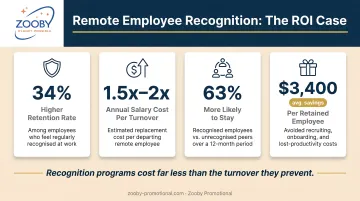
The data backs this up. A longitudinal Gallup and Workhuman study tracking roughly 3,500 employees found that well-recognized employees were 45% less likely to leave within two years. For remote teams where that recognition doesn't happen organically, gifting is one of the most practical ways to fill the gap.
The Retention Math Is Hard to Ignore
Replacing an employee costs between 0.5x and 2x their annual salary — and Gallup estimates avoidable turnover costs U.S. businesses $1 trillion per year. A modest gifting budget, viewed against those replacement costs, becomes a compelling line item rather than a discretionary spend.
Workhuman's research adds another angle: recognition programs at a 10,000-person organization can generate $16.1 million in annual savings through reduced absenteeism and improved productivity alone. That return makes gifting a defensible budget item, not a feel-good expense.
Year-Round Beats Holiday-Only
Many companies default to a December gift and call it done. That approach misses the moments that actually move the needle.
72% of employees say receiving a work-anniversary gift would make them more likely to stay — and work anniversaries happen year-round. So do project completions, promotions, and onboarding moments. Each of those is a missed opportunity when gifting is treated as a seasonal obligation.
The rest of this guide covers how to build a program that capitalizes on those moments — from choosing the right gifts to managing logistics across distributed teams.
What to Give: Best Gift Categories for Remote Employees
The strongest remote gifting programs don't rely on a single gift type. They mix categories based on occasion, recipient, and budget tier. Here's a practical breakdown:
Home Office Upgrades
Practical, workspace-enhancing items resonate strongly with remote workers because they're used every day. This isn't just about utility — every time someone reaches for a branded wireless charger or adjusts their desk lighting, the company's investment in them is visible.
High-performing options include:
- Wireless charging pads and power banks — practical and frequently used
- Mouse pads with built-in charging — premium feel at a mid-range price
- Desk organizers and tech caddies — help remote employees keep their workspace functional
- Branded laptop accessories — sleeves, stands, USB hubs
Zooby Promotional's catalog covers all of these, including wireless charger mouse pads, desk caddies, power banks, and branded tech organizers — all customizable with company logos and ready for individual shipment.
Branded Swag Kits
High-quality branded merchandise does something digital gifts can't: it builds team identity for employees who never share a physical workspace. A well-made branded tumbler or premium apparel item that someone actually wants to use creates a stronger brand connection than a generic giveaway that ends up in a drawer.
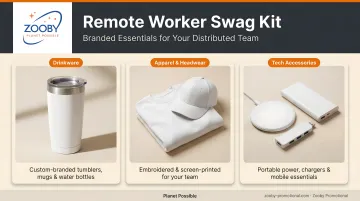
Zooby Promotional sources and customizes branded drinkware, apparel, notebooks, executive gift sets, and bundled swag kits — all designed for single-recipient delivery. Their free Online Company Stores let employees select preferred items on demand, eliminating guesswork on sizes and cutting out bulk ordering entirely. Companies set up the store once; employees order what they want, when they want it.
Wellness and Self-Care Gifts
Burnout and blurred work-life boundaries hit remote workers hard. Wellness-focused gifts signal that the company sees the whole person, not just their output. Options that land well:
- Meditation or mindfulness app subscriptions
- Spa-at-home kits (Zooby's catalog includes spa kits and total comfort packages)
- Fitness equipment or local gym membership credits
- Weighted blankets or sleep-focused items
Digital Gifts and Subscriptions
Digital gifts solve the logistics problem entirely — no shipping address needed, instant delivery, and they scale globally without customs complications. Best uses:
- Streaming or entertainment subscriptions — high perceived value, easy to deliver
- Food delivery credits — universally appreciated
- Online learning platforms (Coursera, LinkedIn Learning) — development-focused recognition
- E-gift cards — flexible, personalizable, and appropriate for international recipients
Digital gifts work especially well for frequent, smaller recognition moments between larger physical gifts.
Experience-Based and Team-Building Gifts
Isolation is one of the top challenges remote workers report. Experience-based gifts address that directly by turning a gift moment into a shared memory.
Strong options include virtual cooking classes, online coffee or wine tastings, team lunches where every remote employee gets a restaurant gift card and joins a video call simultaneously, or virtual escape rooms. These gifts don't just appreciate individuals — they create the kind of casual shared experience that office teams get naturally.
Corporate Gifting for Remote Clients
In-person relationship-building — the conference handshake, the office visit, the client lunch — is far less common than it used to be. For remote-first client relationships, thoughtful gifting is one of the most effective tools for maintaining loyalty and standing out from competitors.
The most effective categories for remote client gifting:
- Premium branded merchandise that reflects the quality of your work (executive gift sets, branded drinkware, leather goods)
- Curated gourmet food or beverage boxes — high perceived value, easy to ship
- Experiential gift cards — spa, dining, entertainment — personalized to the recipient's city
- Service discounts or loyalty offers for long-term clients
Quality and personalization matter more than price — a well-chosen gift signals genuine respect for the relationship in ways a generic giveaway never will. That said, compliance requirements can shape what you're actually allowed to send.
Watch the Compliance Details
Many industries have strict gifting policies and dollar limits:
- IRS business gift deduction: generally capped at $25 per recipient per year
- FINRA Gifts Rule (broker-dealers): prohibits gifts exceeding $100 per person per year
Verify recipient company policies before sending client gifts, particularly in legal, finance, and healthcare. Keep records for tax purposes, and automate policy checks if your team manages high volumes of client sending.
When to Give: Key Remote Gifting Occasions
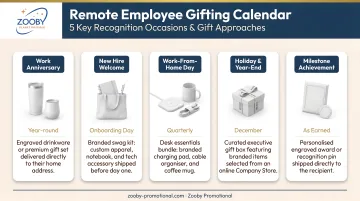
Build a gifting calendar around these high-impact moments:
| Occasion | Gift Approach |
|---|---|
| New hire onboarding | Welcome kit on day one — sets belonging from the start |
| Work anniversary | Expected, meaningful — 72% say it increases likelihood to stay |
| Project completion or major win | Timely, merit-based, and highly motivating |
| Personal milestones | Birthdays, new family members — shows individual attention |
| Spontaneous recognition | Highest emotional impact — signals leadership is paying attention |
An unexpected gift tied to a specific observation — "we noticed how you handled that client situation" — carries more weight than any scheduled holiday gift. It shows someone was actually watching, which is exactly what remote employees rarely feel.
Plan for the Logistics Reality
Physical gifts require lead time. For distributed teams:
- Plan physical gift campaigns 2–3 weeks in advance — more for international recipients
- Maintain an up-to-date shipping address database — employees move, and outdated addresses mean delayed or lost gifts
- Research customs requirements for any team members outside the U.S. before shipping internationally
How to Execute a Remote Gifting Program at Scale
Start with Preference Data
The most effective gifting programs begin with a simple employee preference survey. Capture:
- Hobbies and interests
- Dietary restrictions (critical for food-based gifts)
- Apparel sizes
- Practical needs for their home office setup
Store this in your HR system and update it annually. Without this data, even generous gifts can miss entirely, wasting budget and signaling that leadership doesn't really know the person.
Budget Across Multiple Touchpoints
Don't spend the full annual gifting budget on one holiday gift. A more effective allocation framework:
- Monthly or as-needed recognition: digital gifts and e-gift cards keep morale high without straining budget
- Milestone moments (anniversaries, project wins): physical branded items or curated swag kits at a mid-range spend
- Long tenure or exceptional performance: premium items — executive gift sets, high-end branded merchandise

Frequent, modest gestures combined with occasional premium gifts outperform a single large gift sent once a year.
Solve the Logistics Problem
Shipping to a distributed team is the single biggest operational hurdle in remote gifting. The challenges stack up fast:
- Collecting and verifying home addresses
- Handling international shipments and customs
- Managing inventory for bulk orders
- Ensuring timely delivery across time zones
An Online Company Store removes most of this friction. Instead of purchasing in bulk and manually fulfilling orders, you set up a branded storefront where employees select their items on demand.
Zooby Promotional offers these stores free to clients — no setup cost, no inventory to manage. Employees choose what they want, it ships directly to them, and HR is out of the fulfillment loop.
Measure What You're Spending
Track gifting as an investment, not a cost center:
- Gift claim or redemption rates — for digital gifts and company store orders
- Employee satisfaction scores before and after gifting initiatives
- Qualitative feedback via follow-up pulse surveys
- Retention and engagement data correlated over time with gifting activity
Build for Inclusivity
Remote teams are often geographically, culturally, and demographically diverse. Before finalizing gift selections:
- Audit for dietary inclusivity — don't assume food gifts work for everyone
- Avoid alcohol-based gifts without knowing individual preferences
- Check cultural relevance — some gifts that resonate in one region don't translate in another
- Offer choice-based options where possible so recipients can select what works for them
Frequently Asked Questions
What are the best corporate gifts for clients?
Premium branded merchandise, curated food and beverage boxes, and experiential gift cards consistently perform well for client gifting. Personalization and quality matter more than price — a well-chosen, high-end gift communicates respect for the relationship in a way a generic item simply doesn't.
What is a good gift for remote employees?
The best remote employee gifts enhance the home office or daily wellbeing — branded tech accessories, ergonomic items, wellness subscriptions, or digital gift cards. Impact comes from timing and personalization, not price. A gift tied to a specific achievement lands differently than a box that arrives every December with everyone else's.
How do you manage corporate gifting logistics for a distributed team?
Keep an updated employee address database and plan physical shipments at least 2–3 weeks ahead. An on-demand fulfillment solution — like a free online company store — lets employees select and receive branded items directly, removing the need for bulk ordering or inventory management on your end.
When is the best time to send gifts to remote employees?
Holiday gifting is common, but the highest-impact moments are milestone-based: onboarding, work anniversaries, project completions, and spontaneous recognition for standout contributions. Recognition tied to a real moment carries weight; a calendar-driven gift rarely does.
How much should companies spend on corporate gifts?
A practical framework: small digital recognitions regularly, mid-range physical gifts ($25–$75) for milestones, and premium items ($100+) for exceptional performance or long tenure. Spreading budget across multiple touchpoints builds stronger retention than one large annual gift.
How do you personalize gifts for remote employees you've never met?
A simple onboarding or annual preference survey — capturing hobbies, interests, dietary restrictions, and home office needs — gives managers the data to make informed decisions. Store it in your HR system so the information is accessible without requiring managers to guess or ask repeatedly.